Unlocking Your Potential as a Creative Professional
Unlocking Your Potential - for Creative Professionals
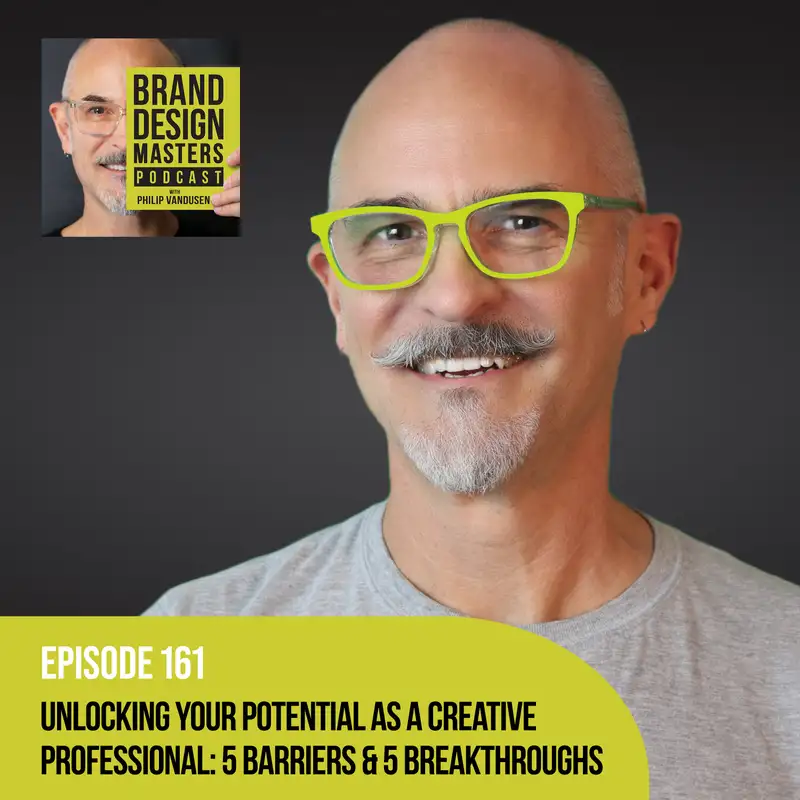
Brand Design Masters Podcast with Philip VanDusen
===
Philip VanDusen:
Hey guys. We're gonna be talking about unlocking your potential as a creative professional, some key barriers that creative professionals hit and some key unlocks.
Alright, so let's set the stage a little bit. Let, let's say you're a creative professional. You have some key talents, some key skills that have been getting you through your career up until this point, and maybe you felt like you've started to hit some challenges or some barriers along the way.
You work in a highly competitive and now very quickly evolving industry and you might have experienced barriers in your career some limitation in your growth. Maybe barriers are hindering your success. Maybe you have some key hard skills that you're hitting barriers with.
Maybe you have some soft skills that you're hitting barriers with. Some of what I'm gonna be talking about today are hard skills. Some are soft skills, some are definitely mindset based. we're gonna be talking about five key barriers and five key unlocks
So first of all, what do barriers look like? [00:01:00] Barriers can be things like a lack of clients. That's the one lot of creative professionals come up against, right?
Low budgets, no funnel or a funnel that's not really performing that well. You could have trouble, attracting clients. You might have low client retention, so your clients are coming in for a one and done, but they're not coming back. Maybe you're not getting referrals through your clients. Maybe you're experiencing some indecision, some low confidence in your decisions or perfectionism or what I like to call and what I have a tendency to do myself sometimes, which is "procrasti-working", which is you're working on low value items, but you telling yourself that you're working really hard, but what's happening is you're kind of doing the easy stuff and maybe not moving the big rocks in your business.
Maybe a barrier that you have is imposter syndrome. Maybe you don't feel worthy, or you are comparing yourself to your competition in an unfavorable and unmotivating way. You could, be struggling with lack of decision making [00:02:00] confidence. maybe you haven't set goals for yourself, or you haven't really planned out your year, or you haven't shared those goals with others, to establish some sort of accountability so you can really keep moving and progressing in your business and in your career.
Maybe you have, as I mentioned a second ago gaps in your knowledge. Maybe that's a skillset gap. Maybe that's how to apply that skillset that you have in a way that's really gonna benefit your business. Or another barrier can be a lack of really meaningful peer network. You might have peers or connections, but are those really benefiting your business?
Is that a really meaningful connection to you? Is that a monetized connection? Those are just a few of the barriers. Another one could be negativity. So that's having just basically a defeatist mindset, not being able to really get past that mindset barrier that you have. Another one that a lot of people struggle with, and I'm gonna be talking about this a little bit later, is personal brand building.
There's a lot of, awareness with Creative Pros that [00:03:00] we have to develop a personal brand, but sometimes there's confusion about how to go about doing that. What are the steps? Personal branding can be, very complex to think about or look at as a whole, but when you kind of break it down and you get a 30,000 foot view on it, it doesn't have to be so complicated.
But there is a lot of fear and confusion about building a personal brand that can be a barrier for creative pros. And I tell you, I am no stranger to barriers. I faced a lot of challenges in my career. If you look at my LinkedIn profile and you read through my cv, you may think I have this flawless career.
Well, sometimes things look that way on LinkedIn or on a cv, but they aren't that way in reality. And I've had some really major career hurdles and barriers in my career. I actually started off with a master's in fine arts, so I have my degree in painting, which actually at the very beginning was a bit of a barrier.
But I didn't start my design career until I was 32 years old. I, [00:04:00] I spent a lot of time in the fine arts and didn't really get into design as a creative professional until I was 32. I've been laid off three times in my career. I've had to move across the country for work three times in my career.
I've been jobless for over a year, twice in my career. I've had four major career pivots. I've gone from fine art to in-house in the fashion industry. Then I went back across the street to the agency world. Then I came back across the street again and started working in CPG as an executive in a big global CPG company back in-house.
And then about 10 years ago, I went solo. but just before I went solo, the biggest barrier that I had I hit a really serious burnout and I'm seriously burned out of my last big corporate gig. And when I burned out and when I kind of hit the street after that, I had seven major barriers.
I kind of thought about this this week, and I was thinking what were these barriers that I had coming out? And so I came up with seven of them, and one was that I [00:05:00] was unemployed. At 54 years old, and to a certain extent as a creative executive, I had kind of aged out of the industry. It was gonna be very difficult for me to reenter the industry at a senior level.
Second barrier was I hadn't designed in 15 years, right? I'd been managing large creative teams for the majority of my career and had not been hands-on designing for a long, long time. So I was like super rusty. I never freelanced before, so I'd never had to get my own clients. I had no idea how to get clients.
The fourth barrier was that I had a huge skill gap. I didn't know anything about creative entrepreneurship or building an email list, or developing content or email marketing, or how to get clients I was a babe in the woods. Fifth barrier was, I had no meaningful network. And this is an important one because I'd been in the industry for 25 years and I had a lot of connections, but all my connections were in global agencies, global, in-house companies.
They weren't going to be [00:06:00] a meaningful network for my launched consultancy. They weren't gonna help me get clients really, because they were operating at an enterprise level. And I was really focusing now on small to medium sized businesses and creative professionals. So I had no real meaningful network that was gonna be able to get me clients.
My sixth barrier was that I had some serious imposter syndrome, I was an accomplished creative executive out there in the world with agencies and in-house, but as an independent, as a, creative entrepreneur, I had no idea what I was doing and I really, really felt like an imposter.
The seventh barrier that I had was, the first thing that I did was I actually started an e-commerce company, an accessories company with a colleague of mine. And we built it and we branded it and we marketed it and we got the products and we started selling the products That took about a year to do, and when we got into it, we realized that we really didn't want to be shipping products all day.
And we dropped the company after just a few months. But the thing that that had done was it got [00:07:00] me through that burnout. It got me back into loving design and really interested in creative entrepreneurship. So while it was a failed endeavor, it actually really. Formative in terms of setting me up for the next 10 years of my career.
But all of those were really, really significant barriers. So let's talk about five key barriers. that creative professionals see a lot.
Barrier number one is having a limited skillset. So this could be limited or out of date skills. A lot of us are starting to feel a little outta date right now with this tsunami of AI functionality that's coming down the pike, both in terms of design development as well as copywriting and strategy and all the different applications, web development, all the different applications of ai.
There's a challenge that we have in terms of, what kind of skills to build. Like what is it that we should actually learn that's actually gonna help us move through the next phases of our career as our industry evolves so quickly.
You may have [00:08:00] limited resources, right? You might not have a lot of funds in order to see you through this or invest in upgrading your skills. You may have a lack of mentorship or a lack of, coaching or peer support or guidance through your career to help you with this decision making.
You may have a lack or a gulf of any kind of learning programs set up or available to you. So looking at those kind of barriers, those limited skill sets, those market challenges that we have. if you've been feeling any of those things, here are just a couple ideas, a couple unlocks that you can use to push your way through that barrier.
And the biggest unlock is continued professional development and investment in your professional development. Sometimes you have to spend money to make money, and one of the things I share with my coaching clients a lot is that most companies spend anywhere from 15 to 20% of their gross revenue per year on marketing, meaning they spend that 20% of their revenue on promoting their business to get more [00:09:00] business.
One of the things I see in creatives all the time is that we don't do that. We just work our network, but it's not like we're actually investing in order to build our business. So sometimes you actually have to invest, but you can actually upgrade your skillset and do professional development on the cheap too.
one of the things that, it just blows me away constantly is the explosion of free content and training that's available on YouTube. , And there are, people in developing countries around the world that make massive use of the learning that's available on YouTube, and we can do that as well.
So if you don't have a lot of resources, YouTube is a great resource for you. LinkedIn Learning is also a really, really great resource and there's tons and tons of really focused creative professional development learning on LinkedIn. And there are a number of different AI certifications that are popping up all over the place.
Some of them are kind of bogus, but some of them are actually pretty strong programs. So you can look into AI certification too, depending [00:10:00] on your curiosity around that and how you see that could benefit your particular career. There's, a guy who I have always been very close to his name's Daniel Scott and he has a Adobe training program called Bring Your Own Laptop.
And I'm an affiliate of Daniels and if you go to byol.me/philip, you can sign up for access to Daniel's entire catalog of Adobe training. And he is one of the best Adobe trainers out there. He's spoken as a keynote speaker at the Adobe Max conference. He has no slouch and his trainings are absolutely incredible and he's got a really amazing vibe to him and he's keeps totally up to date on what's coming out in the Adobe sphere.
And I know there's a lot of negativity around Adobe right now and I share it, right, because they are really squeezing people by upping their monthly subscription to $89 a month. I mean, it's crazy. And so a lot of people are jumping ship on Adobe, but. Like myself, I've spent 30 years in the Adobe sphere, and [00:11:00] so keeping up on Adobe does make sense if that's the way you want to go.
And a lot of people who are in-house, in agencies or in-house in corporations are still in the Adobe sphere. So Daniel Scott's trainings are amazing, and they're like $12 a month. I mean, for $12 a month you can get access to his entire training suite. It's incredible. So go to and sign up for Daniel Scott's Adobe training if that's something that you wanna invest in for your professional development.
And another thing that you can do is you can do some one-on-one training with me. I do coaching for creative professionals. And if you go to philipvandusen.com/oneonone, you can learn more about how I work with creative professionals for coaching .
Another tactic in learning how to unlock your professional development is to assess your skill sets. So assessing what kind of skill sets you have? Do you have a T-shaped skillset? Meaning are you super talented in one particular area? Most people who work in agencies or [00:12:00] in-house have T-shaped skill sets. 'cause those sorts of organizations hire for T-shaped skill sets.
They want you to be an expert in one thing and they will surround you with experts in other things. But when you're a creative professionals who's independent, you really have to think about developing more of a V-shaped skillset. So that's your one superpower, but then a number of different ones that are in varying other degrees.
So think about how you could expand your skillset. And in a previous live stream I did a couple weeks ago, I talked about it in terms of what is your design plus. If you are a video editor, could you get into audio editing? Could you get into motion or 3D design? If you're a copywriter, could you start doing some graphic design?
Could you learn about paid advertising? What is the added skillset that you could tack on to what you're currently doing in order to make yourself more viable and more attractive in the marketplace? You can do this by learning these things yourself, or you can do it [00:13:00] through strategic partnerships.
And that is making network connections, with people who do things that you don't do. So essentially you are expanding your ability to offer more things, but you're doing it through partnerships with others. People who are white, labeling their services under your umbrella, or acting as a partner for you, and you're using them as a subcontractor.
This also goes both ways. You can offer yourself out to others as a subcontractor. This is just one of the ways that you can overcome that barrier and really start thinking about your professional development and investing time and energy in your professional development in a different way.
Alright, the next barrier that I want to talk about is when your network isn't working.
Where do clients come from for creative professionals? On average 60% of new clients for creative professionals come from your network and referrals. Only 15% comes from [00:14:00] promotion and outreach or cold outreach.
Then there's content marketing, inbound marketing, 25% of new clients come from that. But 60% on average of new clients come from your network and referrals. And I challenge you to look at your own incoming new business and new client prospects and see if it reflects this.
See if you are getting major volume from your network and from referrals. And if you're not, and that's something that you definitely want to look at.
You may feel isolated. You may feel that you have a lack of connections. These are the sorts of barriers that creative pros feel around this.
You may have no meaningful network, one that actually results in this sorts of client referrals that I'm talking about. You may not be going to events or conferences. You may not be developing or nurturing or finding new connections. That's what this barrier looks like. So let's talk a little bit about what some unlocks [00:15:00] for the barrier of your network not working for you.
One of the tactics is to join a mastermind group. I'm just gonna be really upfront about this. The mastermind group that I run, Bonfire is just one of those areas that can really, really unlock a lot of challenges and barriers with networks very, quickly. It brings you new opportunities an overnight network of peers who can act as strategic partners, who can refer clients who can, give you that kind of peer feedback that you may be missing. Joining a mastermind group is a really great tactic to start working on the problem of your network not working for you.
Another tactic is to join a professional community. There are a number of them out there.
Some of the members of Bonfire that are part of my membership community are also members of BNI, which is Business Network International, which is a networking group where, you meet with other professionals in different industries and you network with each other to the benefit of each other's businesses.
There's the DMI. So if [00:16:00] you're in design management, that's the Design Management Institute. There are AIGA chapters all over the country, American Institute of Graphic Arts, a number of professional communities. And if you're not involved in any kind of professional community, I challenge you to try to really explore the possibility of doing that.
Another tactic, and I was shocked by this. I've been kind of polling the creative pros that I work with a lot around how many conferences or events they go to per year, and I'm really shocked with how little people are actually showing up in real life to these amazing networking opportunities. And so I challenge you to look into where you might be able to go to a local conference or travel to a more national conference.
Things like VidCon or Social Media Marketing World, or Adobe Max or Fuse or South by Southwest. There's a whole ton of conferences that creative professionals have a tendency to congregate at. Now, yes, I know. You're then networking with people who are in your industry. [00:17:00] They're not outside, they're not gonna be direct clients immediately.
But the thing is, is that they are going to be a meaningful network for you. They are going to be that design plus they're going to be those people that you could develop strategic partnerships with, and possibly work with, Or bring into projects that you have. You could also connect with peers through LinkedIn groups or Facebook groups.
You can exchange ideas and leverage each other's networks that way. Another way is to expand your offering, through strategic partnerships. So you're networking with other creatives who do things that you don't do, and then you're using those people as subcontractors.
So if you're a graphic designer, you might be able to offer a video editing and audio editing. If you're a copywriter or if you are a ad creative developer, you might be able to network with someone who actually sets up ad campaigns and runs ad campaigns on LinkedIn or Facebook. And doing those sorts of strategic partnerships can really expand your ability to offer more and therefore have a much [00:18:00] broader possibility of prospective clients out there broadening that top part of your funnel. That is a great tactic as you look at how you can expand your circle and how you can build a network that is actually working for you and bringing you those referrals.
The next barrier that I want to talk about is indecisiveness and what I like to call the confidence gap.
You have to think about the fact that decision making is a critical skill. So what is the confidence gap? The confidence gap is kind of the distance between knowing what to do and then how to get it done. Or feeling like you have the skills and the motivation and this decision making confidence to actually start moving.
That confidence gap, you know, in your head what you want to do, or you may have an inkling of what you need to do, but you're not able to really kind of put the wheels in motion and get those gears turning. You may have trouble making decisions, how to get new clients, how to market yourself, how to price your work, how to [00:19:00] arrange the copy and the customer journey on your website.
Maybe you have questions about how to organize your business, how to build an email list, how to establish some sort of financial infrastructure or project management infrastructure in your business. These are big decisions that we have to make as creative pros and they're tough decisions, and if you make the wrong one, it can kind of lead you down the wrong path or, or establish a real false start as you grow and expand and refine and improve how you run your business.
Another barrier can be lack of guidance or lack of mentorship.
You don't have a, career sherpa to kind of lead you up the mountaintop, right, to advise you. All of this leads to a level of decision paralysis or if you are making decisions, sometimes making poor decisions.
Those are the sorts of barriers that you could categorize under the confidence gap. So let's talk about few of the tactics that you could use in order to surmount that.
[00:20:00] Building a network of trusted peers. Getting feedback on your ideas, getting feedback On your challenges. Growing that circle of confidants networking to establish a level of business leverage in a really purposeful way, is one of those things that you can do that can really bridge that confidence gap. You can engage a coach like me or find a mentor through LinkedIn or through some professional network, someone who can advise you as a guide to help you make those decisions and someone who has experience, longevity in the industry that can give you some perspective that you may not have.
Another way you can bridge that confidence gap is internally, and that's by setting goals and holding yourself accountable to those goals, sharing those goals with others, so others also are keeping you accountable to those goals.
I encourage folks to set smart goals for themselves. Smart goals are: Specific. Measurable, Achievable, Realistic, and Timely. That's S.M.A.R.T. The acronym. And, [00:21:00] if you search that on Google or on ChatGPT, you can get any number of worksheets or charts that help you set smart goals for yourself.
But that's something that I, encourage you to learn how to do. It can be very, very effective in giving you some direction and setting out a path for you to make progress and work your way through some of these barriers. And here's the really big unlock for this and setting goals for yourself, and that is setting up accountability for your goals.
As soon as you share your goals with others, it become very real. It's very easy to cheat on yourself if you're setting a goal and saying, I have this goal. This is my thing that I'm gonna do, and then you don't tell anybody about it. Those goals can really slip and you can cheat on yourself. As soon as you share it with somebody else and establish some sort of transparency to your goal and some sort of accountability that you have to others.
There's this very invisible and incredibly powerful thing that happens that can help you really move through this confidence gap. And this [00:22:00] barrier, You somehow subconsciously feel that someone's watching and that really, really helps you move forward and make progress really quickly and get the gears in motion to accomplish these sorts of goals.
And that's the sort of thing that comes with a peer network or some sort of network, group that you're part of is sharing those goals and being held accountable .
All right, The next barrier we're gonna talk about is limiting beliefs and self devaluation.
What this barrier looks like is just feeling less than. It can be comparing yourself incessantly to others, and in that comparison, feeling less than, and having that be very debilitating or very immobilizing. Creatives tend to be very sensitive and emotional people. That's what makes us creative. That's what gives us our superpower, but it's also our Achilles heel.
Sometimes we tend to suffer from self-doubt. We have imposter syndrome, I think many times, more so than some other [00:23:00] professionals. We compare ourselves to others a lot. You may have the pressure of having the sole responsibility for the success of your business and feeling very alone in that, that kind of professional isolation.
Those are some of the things that characterize this barrier of limiting beliefs and self devaluation. Some of the key unlocks you can use is to feed your mindset. Finding a network of supportive peers who you can share your struggles with and who you can draw positivity and motivation from is one of those unlocks that takes a little work. But it doesn't have to be as difficult as you think it is, and it's practicing what I like to call "mindset mirroring" by associating yourself and gathering with peers and sharing challenges, sharing your goals, sharing accountability. It sets up something that is, called mindset mirroring.
And I have a quote from a guy named Eckhart Tole, who wrote a very powerful book called The Power of Now. And that quote says,
"When a [00:24:00] log has only just started to burn and is placed next to one that is already burning fiercely after a while when they are separated again, the first log will be burning with much greater intensity, after all, it's the same fire".
And that's the thing. If you have people who are on fire and motivated and moving and growing and progressing in their businesses, they're on fire and you put yourself in proximity to them, you can't help but catch fire too. It's mindset mirroring. It's bringing that proximity together and you can't help but be infected by that kind of positivity, energy, and motivation.
And so finding a network of supportive peers is one of the quickest and most powerful unlocks or tactics that you can use to overcome that barrier.
Another one is to feed yourself really good brain food. And Eckhart's book, the Power of Now is a really great book. There's a million great mindset books [00:25:00] out there.
You have to feed your brain really good food in order to get that motivation. In the lack of having a supportive peer network or in concert with having a supportive peer network to do that sort of thing.
Also, getting an experienced outside perspective can also really help you with this.
Getting a mentor, getting a coach, establishing a relationship with some sort of trusted advisor. It could be a skip level manager at the job that you have. It could be someone that you connect with on LinkedIn. It could be. hiring someone as a professional coach, but to get some outside perspective to help you really see what it is that you're doing and maybe the blind spots that you have can really help you break through that barrier of limiting beliefs and that kind of self devaluation, which can be immobilizing for creatives.
Barrier number five is feeling powerless.
We, in our industry, have lots of opposing forces that come at us.
There's globalization of our [00:26:00] industry. The downward pricing pressure that comes with globalization. There's the commoditization of the work that we do. if you're mid to late career, there's ageism in our industry that can threaten your career. There's the, tsunami of AI that's coming at us right now.
And, that can feel very threatening if you don't address it in the most aggressive way, really. You can feel invisible, you can feel a real lack of agency. You might not have a personal brand or feel visible in that way, or credible in that way, that you haven't established any level of agency that you own in terms of your personal brand .
You could be creating content that's really working to attract clients. So maybe you're not doing that, but you know that you of should be doing that. Feeling powerless around that dynamic of the ability to find your voice and to start establishing some level of visibility and credibility and delivering value online so you can really attract clients through what you know.
[00:27:00] There can be, the fear that comes with the idea of starting to do this stuff. There can be a lack of commitment to, doing it very consistently. You might have challenges like, where do I even start? Like I don't have any ideas.
I don't know even where to start with this, what to write, whether it's writing, whether it's audio content, video content, like what should I even do? The barriers of building that creativity muscle when it comes to the creativity that's necessary in order to start building a personal brand. Those are some of the barriers that.
I would characterize as feeling powerless, those opposing forces, that lack of agency, that inability to understand where to start, or even if you have started, how to stay consistent with that. A lack of being inspired about what to even talk about, what to even share, what kind of value to even put out there.
The tactics around, getting over that barrier of feeling powerless look like this. It's [00:28:00] building a personal brand and establishing a voice around that personal brand. I'm gonna share with you a tool that I developed. A brand positioning statement is a construct that they use in brand strategy, and I've tweaked it so it's geared towards developing a personal brand positioning statement.
A personal brand positioning statement is pretty simple. It's , what do you offer? Who do you offer it to? What's the value that it delivers? Why you're better and why you're different. Those are what's included in brand positioning statement. And I have a tool, it's a lead magnet that, is a PDF. You can type right into the PDF. And the URL, I apologize about this, but the URL is philipvandusen.com/brand-positioning-statement- optin. Okay. I didn't think much about this URL and I didn't do a shortened URL. Sorry about that. But essentially it's a PDF tool and you can download it if you go to this URL. And, there's some instructions and it's a way for you to kind of get your head around who you are, [00:29:00] who you're offering value to. What is that value? Why is it better? Why is it different? Is establishing you and positioning you in the market.
There's another tool that I wanna share with you, called the Personal Brand Wheel. And this is a super, powerful tool. Personal branding can be kind of overwhelming. There's a lot of moving parts to it. And this is a tool that I developed that focuses on personal branding and the, the 12 of key aspects of personal branding. So you can get a 30,000 foot view of what it is that you need to build and also assess what you've done or what you may need to do in order to really look at how to build a personal brand.
It's essentially a targeted roadmap for where to start helps you build your credibility. It helps you understand where you are in the process, and building that personal brand will really help you attract the colleagues and the peers that you need in order to start building that referral engine that's going to ignite your business.
Another tactic you can use in to surmount [00:30:00] that barrier is stop consuming and start producing.
I get asked by people a lot, what kind of content do you consume? What is it that you consume, Philip? And you know what, I actually don't consume a lot of content.
I produce a lot of content, so I don't spend a lot of time surfing, ingesting content. A tactic that you can use in order to jumpstart this process is try to limit how much you're actually consuming and put a little more time and energy into thought about how you could start producing, start a content ideas list.
What do your clients need to know? What are the questions that you're constantly being asked? What are the questions that come up when you're going through the creative process that you do with your clients? What do they ask you? What do they stumble with? What are the sorts of things that you think everybody knows, but turns out a lot of your clients don't know, right?
What kind of education do they need? This is one of the things that I hear also from my coaching clients a lot, and that is like, I am so sick of having to [00:31:00] educate my clients. It's so time consuming. Here's the thing. Educating your clients is the absolute best thing that you can do because you're controlling their understanding of the value of what you're doing. So having that opportunity to educate your clients, shows them the value of what it is that you do, and that's what you can do in developing content. You can start putting out into the world an educational platform for what it is that you do and the value of what it is that you do, because that's going to attract people to you.
So think about it that way. Another way to think about it is if you want to help people who are in your industry, who do what you do, think about where you were a year or two ago. What was it that you've learned in the last year or two that really helped you move to where you are now? What were the challenges you had?
What were the questions you have? What did you just learn and try to. Share that back with the people who are just 1, 2, 3 steps [00:32:00] behind you. It's a really great way to start thinking about how you could get started developing content if you think about the problems or the questions that people have, and start answering those questions.
Another challenge or tactic I have for you around this is to just publish something right now. In that podcast that I published on Monday about AI's effect on LinkedIn and that platform and how it's changing the power of the LinkedIn platform. One of the things I talked about was carousels.
Carousels on LinkedIn are still the highest engagement. format of content on LinkedIn. The cool thing about carousels is that they are snackable, so it actually doesn't take a lot of writing, doesn't take a lot of copy that you have to develop to do a carousel. And there's a lot of templates for carousels out there.
So you could write like 150 words, 200 words of content, break it up into a dozen slides, have some cool visuals around it. Your last slide is a call to action with contact information for you. It's a really low lift way of [00:33:00] starting to get into content. LinkedIn is the best platform to do it, and carousels are the best format to do it in, and it's a great way to get started.
You wanna start, you wanna start to be heard. You wanna start to be visible. You wanna start to share what you know. That is one of the best ways to get over that barrier of feeling powerless.
Now I want to share the biggest badass unlock of all, and that is a mastermind group. I run a mastermind group called Bonfire.
It addresses almost all of the things that I was talking about here today. It addresses growing your skillset, moving from a T-shaped to a V-shaped skillset. It addresses marketing challenges, so the threat of AI and all the changes that are happening in our industry. Because of that, being part of a mastermind group also helps you network and build a peer network literally overnight.
When you join, you have peers who are in your industry who are gonna have your back and give you [00:34:00] feedback and help you get over that confidence gap in your decision making. They also can act as a referral source for you. They can also act as a collaborative or strategic partner resource for you.
The feedback that you get can really help with those limiting beliefs and that level of self devaluation that I was talking about, it can help you feel less powerless. You can feel less victimized. You can feel like you have more agency in your career. And also, I run Bonfire and it's a group coaching and mastermind platform, so I provide group coaching to all the members in that group.
Depending on the level that you're in, you can also get one on one direct coaching from me at about a 50% discount to my usual rates. so you can get that level of mentorship from someone who's been in the industry for 30 plus years, both on the agency side, client side, and also building my own personal brand.
My own content engine and my own business. I've done coaching with hundreds of creative professionals [00:35:00] and mentored hundreds of creative professionals through my career. I've, interviewed more than 4,000, hired more than 400 creative professionals in my life.
So I've been there and done that, and I bring that knowledge and that depth of experience to my Bonfire group. And I want you to keep this in mind. The people that you surround yourself with are more critical to unlocking your potential than anything else. You have to be in the room with the right people to really establish that level of mindset mirroring that is going to move you forward.
That story that I told you from Ekhart Tolle in his book, the Power of Now, when you surround yourself with other people who are on fire, you cannot help but catch fire too, which is why I named my group Bonfire, because we gather around and we give each other power. We give each other insight, we give each other support.
It's an amazing, group. You're surrounding yourself with a group of peers who are on the [00:36:00] same journey. You have access to me as a mentor and a coach. You will get guidance and inspiration and accountability to your goals. It will add rocket fuel to your development and your ability to unlock your potential.
You get tools, you get motivation, and more than anything else, you're just not alone in this journey anymore. Mastermind groups were one of the things that when I burned out outta my big last corporate gig and I was up against those seven barriers that I told you about, mastermind groups were the thing that got me over that I joined a paid community and got really active in it, and I moved forward so much more quickly and unlocked my own potential that really led to my doing what I'm doing now.
and that's why I'm so passionate about it, and that's why I've run mastermind groups for the last five years. It, really changes people's lives and I'm super passionate about that. Bonfire is held on Zoom, so we meet four times a month. Two of them are mastermind sessions. One is an [00:37:00] office hour session and one is either a visiting expert or an inspiration session all of this is recorded. So session recordings are online and it's a private online community. It's gated. So if you're not a member, you can't get in. There's a tremendous resource library of playlists and downloads and checklists and PDFs and toolkits and tutorials that are available, to people who are members of the group that you can download from the moment that you walk in.
You also get a substantial discount, a 50% discount on my brand strategy 1 0 1 course. So if you're interested in learning brand strategy, it's a great way to get started with that. The other cool thing about it is that because I am leading this group, if you take brand strategy 1 0 1, I am there to help lead you through the implementation of that strategy capability within your own business.
And in terms of investing in your business. At the beginning I was talking about how most businesses invest anywhere from 15 to 20% of their annual [00:38:00] revenue in promoting their business. The membership for Bonfire is $97 a month. It's $291 quarterly. So there's a discount so it's extremely affordable and I highly recommend that you check it out.
If you go to philipvandusen.com/Bonfire, you can read about the different levels of Bonfire. It'll be the best investment that you've ever made in your business.
It's an amazing group and if you are experiencing any kind of barriers in your business and you feel like you really need to unlock your potential, I guarantee you it is a fantastic place to do that. And so, again, if you're interested, go to philipvandusen.com/bonfire and check it out.
If you are interested and serious about possibly becoming a member of Bonfire, hit me up either through email or via LinkedIn. Let me know that We'll jump on Zoom, we'll talk about where you are in your business and we'll see if Bonfire might be a good place for you.
This has been [00:39:00] awesome. Thanks for joining me today. I appreciate your being part of my world, and, I hope you have a great week.
So with that, see you next time.