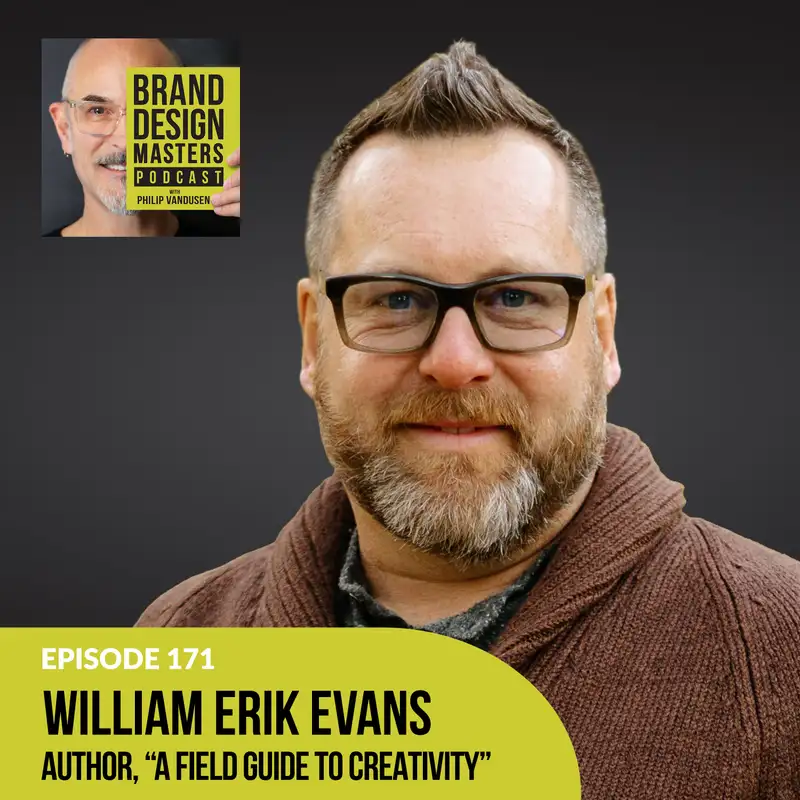
Erik Evans: Creativity is an Act of Rebellion
Brand Design Masters Podcast with Philip VanDusen
Episode 171: Erik Evans-Creativity is an Act of Rebellion
===
Philip: [00:00:00] Eric. Thanks for coming on the podcast. This is gonna be really great conversation. You've had an incredible career arc. You've worked for Pixar, one of those companies that a lot of creatives, I think, dream about in their careers. Facebook, Cisco, Salesforce, and now you run your own solo practice and are building a workshop called The Story Workshop, which we're gonna get into later.
You've also recently written a book called Field Guide to Creativity: Strategies for Thriving in Any Creative Era, and I would venture to say we're probably in a very new creative era right now. So that's gonna be another part of the conversation. But you had this great career arc from, working with big brands in-house to now going solo.
Talk a little bit about that arc.
Erik: Yeah. Thanks for first of all, thanks for having me on. Thanks for this conversation. I'm excited to get into it. So yeah, my my journey is just very different. The big hook in my book right from the start is that I've had [00:01:00] 48 jobs and counting. I've had this kind of crazy career.
So almost for every, almost every year I've been alive, I feel like I have a job that I can attribute to it somehow or another. And so yeah, I started off as a creative junior designer working in print. I w- worked my way up in San Francisco working at a little company, a publishing company called Weldon Owen.
I worked on big brands like Pottery Barn and stuff like that, and it was really fun. But then I made a shift somewhere in there. I I kinda worked my way up to this art director during kind of the dot-com boom, and then when that kinda came down a little bit, I was laid off. I kinda reinvented myself.
I went back to school for animation. I studied how to illustrate and animate and learned how to animate by hand, and luckily enough, I did get a job. I landed at Pixar. I kinda learned a lot when I was there. But that wasn't even the right fit for me there. I kinda... I was there for about four or five years.
I really enjoyed it. I worked with great people, but then I kinda felt like it wasn't the right fit, and I kinda moved on from there. I went back to grad [00:02:00] school. Then I started working for a company called Duarte Design, learning how to do branding and storytelling for big brands, and then that led me to going in-house.
I started working for ServiceNow as an in-house art director, and then that from there really skyrocketed. I had a couple people who liked me at ServiceNow who left and would take me with them to startups, and I got to work for a company that was purchased by Cisco, and then I just went into this whole startup realm from there, and I was rising up as a kind of creative art director and that's kinda where I'm at now.
So I had this background in startups in the last few years, and now I'm kinda repositioning myself once again as kinda this, a little bit more of a thought leader and kinda bringing to the table all the stuff I've learned over the years.
Philip: And you've moved. You've moved from San Francisco. We're both kind of Bay Area, you know- Yeah
I guess alumni, and now you're in the middle of Oregon. What's that kinda move like?
Erik: Yeah, my wife and I wanted to make a change from the Bay Area. We were [00:03:00] just ready to try something different. We moved to Bend, Oregon, a place that we had been vacationing for a long time with other families from the Bay Area.
It's not that far, really. It's A full day drive, but it's a beautiful mountain town here. We have a ski resort. We have rivers that run through it. We have, I'm out kayaking and out with my dogs a lot, and it's just a different lifestyle. So I'm more remote, that's true, but, technology makes it available to talk to anybody anywhere, just like I am with you in Woodstock, New York.
It's great.
Philip: So in your book... Let's talk about your book a little bit. So you've written this book, Field Guide to Creativity, and so what would you say is the most durable thing that you know about creativity, that doesn't change no matter what era that you're in?
Erik: Yeah. I- for me, creativity is... it's this, the... You gotta be in the fight. You gotta be in it. You gotta really stick to it. I think everybody who's in the creative field started off as this child who could draw or do things or had [00:04:00] imagination. Leads us to working and getting into this world that, you gotta navigate.
And creativity is something you really have to work at, I think. It... I have... In my book, I talk about the practices of it, and really it's a daily practice every day. For me a really big part of it was reading The Artist's Way and integrating my morning papers and stuff like that. That was really a illuminating time for me, and I still do it.
The morning papers every day help me lead into this writing. I didn't know... I don't consider myself a writer. I am more of a creator, I think, and this book is just the culmination of all of that. So to answer your question, I think it's a daily practice of being creative, and it's worth the fight, but you gotta be in the fight.
And I think there's some longevity to it too. You're gonna see all these different peaks and valleys of your career, but it's worth it, I think, in the long run.
Philip: So you also talk about sincerity being a superpower, and you said this one thing that I thought was real interesting. You said that sincerity is a creative superpower, that...
and that cynicism [00:05:00] might look smart, but sincerity is what makes meaningful work possible. And definitely we live and work in a, what can be a fairly snarky kind of profession. And so where does that come from for you?
Erik: I felt like I was using, as a younger man, I felt like I was using cynicism as a shield.
I felt like I could stay detached from things, or if I was ironic about something or not really showing what I felt about something I couldn't be hurt by something, or no one could be, could get to me, and somewhere in my late 20s, early 30s, I think I just looked at people who I really admired, who were true artists, who really loved things deeply, who showed emotion, and there was something about that for me.
It was like, that's really what I wanted to be. I don't wanna be disconnected from anything, I wanted to be really in this life, and I think, something about fatherhood to me was about that too. I wanted to model behavior for my [00:06:00] kids where the patriarchy didn't get to me, I show emotion all the time.
I, I cry at the, at a commercial on TV or a lyric in a song. I feel emotion a lot, and I just decided that's who I'm gonna be. I'm gonna... I'd rather be that person, and I wanna wear my heart on my sleeve a little bit. It's a little cringey sometimes. I get it. I definitely approach things with a vulnerability, and I show my emotion about how much I enjoy things, and I enjoy a lot of things.
I definitely am a collector of things and into things and it's a big part of my life now, so I just embraced it. Yeah.
Philip: Do you think that kind of a sincerity or that kind of feeling is something that is a symptomatic or built into most creatives, or do you think it's something that you can teach?
Or is it more something that you ha- this- you have to unlearn the cynicism in order to get your way back to sincerity? H- what do you think about that?
Erik: I, I guess my, speaking from my journey, it was unlearning something. I think we were born these sensitive kids as artists.
[00:07:00] And and revealing yourself in a creative way is very vulnerable feeling. You get judged a lot. And I still get judged all the time with the work I put out. Someone's gotta look at it. Someone's gotta make a call on it, whether it's working or not. And I had to learn over time to not take things so personally.
Sometimes I feel like my back's up against the wall, or I'm defending myself, or ... And then I gotta learn it's just not, it's not a personal thing sometimes. It's just like I'm showing the ideas. I have a skill set in place now where I can attack almost any problem creatively. So I think that cynicism breaks us as a kid.
We learn somewhere along the line that we don't like what we draw. Someone says something that, to us, that makes us feel weird or vulnerable, then we put up a shield. And me and this book, and it's really trying to break that down a little bit. I want people who read it to, to reconnect a little bit.
It's not for ... Really, the book's not even for creative people necessarily. It's for people who maybe are feeling apart from being creative and can ta- I want them to, I want them to tap into that again and feel that again. So [00:08:00] that's how I approach it,
Philip: that's really interesting. You use the word weird, and one of the things you talk about, and one of the themes you tap into in your book is that weirdness is a superpower.
Can you talk a little bit about what you mean by that?
Erik: Yeah. I, it's ... To me, it's the little quirks and the little things that make us unique is a real, to me, superpower. For me, it was comic books. T- comic books to me were a, an avenue to go down as a kid that I could spend hours just doing and looking at and enjoying the artwork and the stories, and it was just this world that it unlocked for me, and it led to animation.
It led to film. And then I could see as I got older, I went back to comic books, and I use it all the time for inspiration. It's just a constant fountain of inspiration to me. Page layouts and hierarchy and color and how they use tangents and overlapping things and my work tends to be like that.
I like it to be bold and colorful and big and poppy. That's the stuff that [00:09:00] appeals to me. If you hire me, you're gonna get my taste on things and that weirdness that I have inside of me is what I bring to the table as a taste maker, as someone who brings that to the table. If you don't like what I'm about, you can
There's other flavors out there. I totally respect that, but they have their own weirdness, too, and you're gonna pick that. And for me, these are my weirdnesses, and I think it's a strength.
Philip: Yes. The weirdness as your superpower is one, is talks to one of the things I talk a lot about, which is finding your differentiation as a creative professional or in your business, and owning that point of difference or celebrating that point of difference.
Which is, I think, for a lot of creative people, scary, because no one wants to be called out as different and everyone wants to fit in a way. And like you said, you're opening yourself up for criticism. So when did embracing your own weirdness start to work for you professionally?
Erik: I know exactly when it took [00:10:00] place.
I, I had this moment somewhere in my career where I was wondering if anything I was making had any value or any worth. I- it was this career crisis where I was like, "Oh my goodness, it's just making a cool logo and a webpage and a thing. Is that has any real value?" I had friends who were doctors and lawyers, and I felt like...
I was like, I was really questioning my choices in life of a career. So the funny thing I did is that I decided to do a giant remodel project in the backyard of my house in the Bay Area, and I had a fear of power tools. For some reason, I didn't know a difference between a Sawzall and a chop saw, and they intimidated me.
It just felt like, how do I do these things, right? So I had a... One of my best friends is a general contractor. I said, "Hey, I'd like to hire you to come down, live with me in the Bay Area for a week or two. I'll pay you to teach me how to build a deck, pergola, everything." So when he started coming down, working with me, he was [00:11:00] sleep- staying at my house in our guest room, and we would start working.
I had this moment where- I could do it. I g- my problem-solving skills were really strong, and I could work with my hands. He would show me how to use a chop saw or something like that, and then I could build a deck, and I was like, "Oh I can do this. I don't have fear of the power tools anymore."
I... Matter of fact, I bought all the power tools, so I have them all. But what I really felt was that I could problem solve in the moment. I knew how to make things meet together. I knew how to measure things. It was all these skills that I'd learned over the years of being a designer that actually came through in my mind and my hands, and then I could build things.
And that was a moment where I was like, "Ah, there's real value. There's real value in this," and it's connected, and it felt really good to me. I think I needed some kind of feeling of a realness to my work. I'm a... I come from a blue-collar family. I've always worked for a living. I've always, paid my bills that way by working and doing things.
And sometimes when you're just creating, to create it [00:12:00] feels... I don't know if it has the value. Sometimes you want it to have the intrinsic value. But by making things and then feeling connected to that, it felt really good to me. So that's that moment that happened for me, and it was somewhere...
my kids were young. They were even helping me work in the backyard and doing all this stuff, and that was really cool, too
Philip: so you were talking about comics, and one of the things that are in comics are monsters. One of the things you talk about in your book are monsters in disguise, and those monsters being things like procrastination or perfectionism or fear.
And so what is your biggest monster, and how do coach people on how to face their monsters?
Erik: Yeah. Monsters to me are metaphors for other things, and to me it was about shadow work. It's shadow work on ourselves. We look at the things that, that we aren't liking. When we see a trait or a value in somebody that rubs us the wrong way, usually that's there to tell us something.
That's telling us something about ourselves. For me, it was like I'm terrible at organiza- organization [00:13:00] and scheduling and things like that, so that that monster, if I name it, that scheduling monster, I can say, "Okay, I can control it." Once you name something, figure it out, and control it that way, you have power over it.
And those monsters in our lives, for everybody, it might be, the imposter syndrome is a big one, right? I, that one always I think gets everybody, especially when you're trying to do something in life. You feel like you're not worthy of it. Procrastination is a huge one for creatives, always "I will do it tomorrow.
I will do it when there's a period of time. I will do it when I take the summer off." That time never comes. That time never comes. You gotta sit down, your butt in your seat, and do it. And yeah, so those monsters are really... f- first of all, they're fun for me, 'cause I love monsters. I've always loved them f- from when I was a kid.
I loved the Universal monsters. I love all the monsters on the cereal boxes. Everything in life was just like this cool thing f- design-wise and illustration-wise. And so now I bring it into my work. When I coach, when I work with people, I want them to talk about their monsters, what those are. Let's name them, let's [00:14:00] have some fun with it, and let's break it down.
So it's kinda like a shadow work that I like to do.
Philip: Do you think that you, someone needs to have that kind of outside perspective or that other point of view to help them define or even find what their monsters are, or do you think that people can recognize that and do the work on their own?
Erik: Boy, that's a really good question.
I... That's an internal question that's hard to answer. I think I can do coaching and exercises to kinda bring it about, but I think you have to be on that journey a little bit, right? I think you have to have these questions about yourself, and maybe you're frustrated. Maybe you're not getting where you wanted to go, or your career has stalled in a way that you didn't like it to go, or...
And again, this isn't about creatives, and this isn't about me. I'm really... I really do wanna help people m- move along and discover things about themselves in life. That's really where my joy comes from is that kind of journey. I think it comes from within. I think you gotta be willing to do the work a little bit too, that's important.
Philip: So Force, how would [00:15:00] you describe the person who needs to read your book? What is that professional, creative professional, or even non-creative professional going to walk away with having or feeling as a result of your, reading your book? Or what is a way, different, flipped that on its head, what is the problem or the feeling that someone may be having that your book might help address?
Erik: Yeah. When I sat down to do this, I definitely put down case studies of people that I was trying to reach, and I knew there might be young people out there just starting their careers that feel really threatened by AI. I feel like there's people in the middle of their careers that are like, "Wow this creative career maybe didn't go the way I wanted it to go, and I'm doing something farther away from where I thought I would be."
My exercises in the book are very gentle. They're hands-on and heartfelt, and they're not like... I'm not reinventing the wheel here. These are things that are in other books you can find in other places. My thing was taking it from a creative person's point of view funneling and [00:16:00] filtering it through my perspective of this kind of crazy career arc I've been on, up and down on.
And then I think if you actually did the steps in my book, like really did it, there's no way you couldn't transform your life in some way or another. There's just no way. If you did exactly what I said... Look, I work with a life coach. I've worked with a life coach for 20 years. I hired her somewhere around 2004, 2005, and I've worked with her every day since then in some form or another for 20-plus years, and it's transformed my life.
There's just no way that it hasn't. I- she asks me to do something, I do it. And I show up and I'm accountable. I need it. I need to be c- accountable to someone. That's a big part of my journey in life. I need someone to ask me to, "Hey, I need you to do this. I'll meet you next time." And then I go, "Okay, I better do this," but if it's just me, sometimes I'll be like, "Oh, I won't... I'm not gonna worry about it."
Philip: Yeah. But- I'm a big coach- Yeah ... mastermind proponent, and I think they're... You definitely have to have accountability and put yourself out there, your goals out there. Because if you [00:17:00] don't, you'll let e- anyone, everyone will let the deadline slide or they, they won't check up on themselves.
It's very difficult to do that on your own, in my opinion.
Erik: It is. I like the accountability part of it. I like the exercise part of it, and I like having someone who's got you and knows you and is there to steer you along because it's challenging. Life is challenging, and I think things get in your way and it helps you kinda get, keep going forward.
I think that's my big thing and I love that. I feel her name's Ginny, she's always in my corner. We talk a lot and I, I've never met her in person, but she's like probably one of my best friends . It's such a crazy feeling in life. So even that, just the coaching part of it is huge.
And then like parts like, it sounds silly, but I, I do a vision map every year on New Year's. My... I sit down with my kids we make a plan for the year. And then now my kids just do it on their own and I see my daughter making hers and she's getting ready to leave for college and it's just very like detailed and clear, and she can follow a path.
She knows [00:18:00] like the friends she wants to make, the g- the grades she wants to make the hobbies she wants to join when she's in college. And I'm like, if you see it every day, if you have a little map on your wall every day that you're looking at You're gonna follow it. It's gonna happen. And your brain is gonna also put connections together all the time with things that you're finding out in the world.
That's the g- that's the great part of it. So again, my book has very, things that aren't brand new. I'm just putting it in place and showing you how I do it, and I think you'll have results if you do it as well.
Philip: So you're starting this workshop called The Story Workshop. Are the exercises that you give or that you prescribe in The Field Guide to Creativity similar to what you're doing in The Story Workshop, or are those sort of things fairly different from each other?
Erik: Yeah. And just to be clear, th- the... my company is called The Story Workshop. The actual modules, I call it Identity by Design. But the book inspired this journey, and then I wanted a workshop at the end of it [00:19:00] that felt very much built upon that.
So years of being a creative director, I built all these brand guidelines for all these companies that had nothing to begin with. I would show up at a startup, and maybe they'd have a logo or some colors. But when I sat down and said, "Hey, let's figure out your core values, let's figure out your mission statement, let's figure out what these colors really mean and how they align with your logo," and then when I got really deep into it, 'cause I started to just love brand, then I saw how powerful it was, and I saw the difference between startups that had core values and a mission statement, and the difference between the ones that didn't.
And the ones that didn't, I knew they weren't gonna work. I knew it wasn't gonna be successful the way they wanted it to be. And that was my takeaway. So long story short, I created this Identity by Design workshop to be building your own personal brand guidelines. And Philip, if I sat with you, we would run some fun exercises bye...
b- but by the end of the day, I would know what your core values are, I would know what [00:20:00] your mission statement is, I would know what your special sauce is that you're bringing to the world. And at the end of it, you would have a logo, your brand colors, your whole thing at the end of this one-day workshop.
And when I started giving it and lear- teaching it and figuring out how to do it, I was surprised how powerful it really was at the end of the day. So that's it. That's what I'm building on.
Philip: That's excellent. And so who's it for?
Erik: That's a funny question. I think it's for everybody really. It's for if you're wanting to go on this journey and you're interested in a little bit knowing more about yourself, for me, it'd be really fun to go to places where people have never thought about this stuff before.
If I worked with more creatives, I feel like they're already understanding that stuff a little bit. What's really exciting is when I work with people who are like, "I've never thought about this before. I've never thought what my core values are. What do, how do, what do I stand for in this life?
What, how do I make..." How do you make decisions? Literally companies that have br- good brand guidelines like Starbucks and Coca-Cola and Nike and Apple, [00:21:00] they can refer to their brand guidelines to drive every business decision possible. So how about a human has those as well? It'll drive your decisions going forward.
It'll make it easy. It'll make your life easier. So it's for, I'll say it's for everybody, but I'll say it's for every Eric Evans that's out there. That's how I pitch it. It's like maybe it's not for everybody, but if you're a little bit like me, whether you're a boy, whether you're a girl, whether you're young, whether you're old, if you're kinda like me, this would be for you, I think.
Philip: So you've worked with a lot of startups, and you were talking about brand guidelines or brand strategy essentially, and how s- a lot of companies don't see the value in it. So tell me some horror stories about the startups that you've worked with or what you think, where you think that stems from. I have my own opinions on this obviously, but where do you think that stems from in their not embracing that aspect of building a brand?
Erik: Sometimes it's not... Sometimes people just have started a company and maybe got a little lucky [00:22:00] and got things going a little bit. Maybe they got some seed money and things started building. But I think that has a has a ceiling, a cap to it, right? So when I started working with a couple of companies, I remember sitting down with them and I said, "All right, I know you want to do all these things to execute this year, and you want me to figure out some of these problems, these creative problems for you, but I don't have anything to go on.
So let's sit down and talk about, why did you start this company? What is the value of this company?" To- And they, when they looked at me like that didn't matter. "Oh, that doesn't matter. Why, what, why would we wanna do that? Let's just do, let's just make it look cool. We have, we're blue. We're a blue company.
We have a logo." I would walk away from that meeting going, "Oh, man, I'm, this is not gonna work." I know I can... Yes, maybe the thing I can make look, would look cool, but ultimately, it doesn't serve the purpose at all, so that's, it's disappointing. It's sad to me in a way,
Philip: do you think that they're just moving too fast to want to take the time to look at their competitive set, [00:23:00] decide on what their mission or, brand positioning is do that core strategy work?
Are they really just more around getting the seed money, getting the product out there, and then thinking about the exit?
Erik: I think that's exactly what it is. I think it's about money. Maybe they feel like that's what is successful at the end of the day- ... is just having that exit strategy or the money or your investors get their investment back and and doubled it or whatever it would be.
That's fine. Listen I don't begrudge anybody making a living or even creating something. Someone created something, made a company. You're so close to being so successful, like, why not go for it in a really good way? Like, why not put all that brand positioning in place? And then you're...
Even the people you hire will feel it. They'll look at your, they'll look at your HR document and understand "Okay, I'm joining this company, and I feel really good about it because of their core values somehow match mine somewhere along the line, and I can feel aligned with this company." Honestly, the best experiences I've [00:24:00] had was, is with companies that align a little bit with my core values somehow or another, so I feel good working for them.
I think everybody does.
Philip: Yeah, that's true. All right, so I wanna talk about the big elephant in the room right now, which is for everybody, whether they know it or not, AI. And I'm gonna relate it back to s- is an aspect of your book, and in your book you said, "In an age of uncertainty, disruption, and technology, creativity is not a luxury.
This is how we adapt, connect, and keep moving forward." How do you think creativity is going to be an unlock for us as creative professionals in dealing with this tsunami and this, completely changing landscape and era that we find ourselves in right now?
Erik: Yeah, it... And I feel it very much too. I'm I'm nervous about these changing times as well, but I feel very hopeful as well.
I I see creativity as an act of rebellion purely. I see [00:25:00] it as like sitting down to make something that wasn't there before, and you have these tool sets that you're bringing to it, whether it's a painting, whether it is even graphic design and branding elements, and you're bringing something new to the table, that act of rebellion is important.
And and I just see it as this like I call it hope punk. That's not my term. It's a term that I've embraced, is that like the journey of making it has value, and putting it out in the world has value, and sharing it with other people really means something. And I really believe it's gonna be artists that lead us through this AI time.
I think that AI obviously is looking at everything we're doing as artists, taking it- Putting it out there as quickly as possible. And it's, it is exciting. I've worked with it. I think it's very cool, and I see... But I also see hope. And my son, who's also I have twins, he's about to leave for college as well.
I've talked to him exclusively about AI and his thoughts and his generation, and he... [00:26:00] Obviously, a lot of people are hating AI right now. You see it when these graduation speak speakers are going off, and everybody's booing them when they talk about AI. And I asked him, "What, how are you gonna battle this?"
And the younger generation is getting together more often. They're going to live events. I think live events are gonna be huge. I think music is gonna be huge. I think fashion's gonna be a part of it. I think repurposing is the big thing that I'm seeing a lot. They're taking cool brands, and they're refashioning them somehow to make them new and cool again.
And I think that feels like what's gonna happen to me. I think these are artists out there that are gonna reinterpret this stuff, redo it, and real experiences are gonna become what's valuable. I think the limited edition things, I think the people that make things by hand that feel real to you, made out of real materials those things are gonna become more and more important to us as a society.
And it kind of ties in with my book. It ties in with these workshops. I want to want... i'm running workshops that are very hands-on. I want to get people using a pencil and [00:27:00] pens and drawing. And part of it is I teach you how to make a comic very quickly. And you'll come up with a story very quickly.
I know how to do this stuff, and- It's fun. It's fun to see that stuff happen, and I think people can see value in that. So to answer your question, I still have anxiety about AI, but I am also very hopeful all the time. I feel extreme hope right now, so I like
Philip: that. So are you using it in any part of your business?
Erik: I do. I definitely I definitely have subscriptions to Claude. I use it I use it really as a kind of a strategic and scheduling tool in a lot of ways. I tie it in with my Gmail, and I make sure that I'm on top of things. 'Cause that's my weakness. I told... That's one of my monsters is being organized and being on top of my schedule, and my wife makes fun of me all the time.
"How do you run this life that, you know? I have... I got my dentist appointment over here, and I don't plan it over here." And so I definitely plug a lot of things through it, and I think I use it a lot of for strategy, of just thinking things through. I spend a lot of time by myself and thinking and [00:28:00] being creative and trying to write and do these things, and I like a little bit of the AI to bounce ideas off of and get some feedback that feels well thought out anyway.
I think so. I think it is. I like it. I have fun with it. How about you? What do you think about it?
Philip: Yeah, I use it as an ideation partner in some cases. I use it in coaching a lot actually, 'cause I take the recordings of my coaching sessions. - I transcribe them. I take those transcriptions and turn them into summaries and, summary emails that I can send to my clients.
It's allowing me to be so much more robust in what I deliver to my coaching clients than I ever could have done profitably when I was doing it before. 'Cause I didn't have time to go through ano- re-listen to everything and take all the notes and send summaries and all that sort of stuff.
It's forget about it. And so that's super helpful to me. Yeah, and it's helping me also, sometimes ideate or come up with variations of things like YouTube scripts or YouTube [00:29:00] titles and it's helping me write, client emails and things that are just, day-to-day slogs that are not using my creative brain.
And plus .. I never learned to touch type. I look at my keys, and I only type with four fingers, and it's the one thing I wish I'd done differently in my career, it's learn to touch type.
And I never got there. One of the things I wanted to ask you about was that, y- when we first talked , you were describing your journey through corporate in-house agency work, all that sort of stuff, and I saw a lot of myself and my own journey through those sorts of things.
And now you're in this pivot point where you've gone independent and you're developing your own products and your own workshops, and you've written a book, and you're now growing this more solo endeavor. What was that pivot like for you in terms of your mindset? How did you adjust from one side of that fence to the other?
Erik: Yeah. [00:30:00] I think the whole journey started where I felt like I had this really interesting career, and I think when I was... I'm al- I was always behind the scenes, right? So I'd be behind the scenes at these startups doing cool things, and I was like, "No one's ever gonna know who I am." No, I'm just in a...
I'm just a nameless face in a sea of creative things that I'm doing, but I felt like my work had value. So starting on the book and I kinda wanted... I started off as a talk. I wanted to be asked to creative conferences, and I just wanted to be a part of the conversation. I wanted to be able to get up on stage and then say, "Hey, this is my career.
This is how it went. Maybe it helps you in a way," right? But it... I couldn't get that invitation because no one really knows me, right? So I was like I'll take this kind of creative talk that I've made into this book format." And then I knew once the book struck a chord and I started working with this, my, my publishing company, Raven and Grace, I knew I was onto something and I was on the precipice of this change, and I knew if I had the book, it gives me this [00:31:00] anchor point that might lead me to something else.
So the interesting thing is I've already started to put proposals out there for talks. People have asked me now, "Can you submit a proposal for next year, for 2027? We would like to have you on a kind of talk circuit," or something like that. I can't believe it. Like that... I can't believe it worked. Like I didn't know it would work.
I just knew that I needed to keep moving forward. And then I think becoming an empty nester in the next year or so, this next year is gonna be crazy with my kids leaving, I knew I had this opportunity. I knew I was different, right? The last 18, 20 years, I wanted to be a father. I wanted to be a present father that was home.
I didn't wanna work super late. I didn't wanna work weekends. I wanted to be available. And I was. I I definitely was around, and I definitely have made this impact. I think that being a father was the big key thing in my life, and it also unlocked a lot of creative things for me. But now I'm in this different place, and I'm ready for it and I'm excited to see what that comes.
But it's definitely been these building blocks putting in place with this [00:32:00] realization that this time is coming for me, and I feel ready for it
Philip: How did your sense of personal identity change, or how is it changing as a result of that?
Erik: Yeah. Again, I'm gonna go back to that p- imposter syndrome thing where I was kinda fighting through it.
I was always like, "Who am I? Who am I to write a book?" Or, "Who am I to say this or that?" Or... But, the more I thought about it, it's like I've always been I've always thought about things differently. I've always approached things differently. My wife says even when I talk to people I sound like an alien sometimes.
I say things differently. She goes who says what you just said to that person?" And I go, "I don't know. I just, it's just how I'm going through this life." And so I just feel like I had something to offer and fight through this, like the imposter syndrome was a big part of it. And now just going forward I feel like, again, I just wanna face the fears, right?
The public speaking part of it. I know if I'm gonna be giving a talk up on stage, that's really scary to me, but I wanna do it. I know I wanna do something different, and I wanna try, and if I don't try I'm gonna be really disappointed in myself. And so [00:33:00] it's a good time. A lot of skill, a lot of things that I've learned.
It's just this good time in my life. I couldn't have done it 10 years ago. I couldn't have done it 15 years ago. I can only do it now.
Philip: Do you think that writing this book and putting that out there was, to a certain extent, this level of putting a stake in the ground and the fact that you are going to have to be accountable to this book?
Meaning, meaning you're gonna have to show up behind the book in a lot of different ways.
Erik: Yeah. Yeah. I do think it's important to me. I'm, I am putting a stake in the ground. I, there's no doubt about it. I'm trying to change my own life, my own career in ways that I wanna go forward. I wanna be the creator of my life now, whereas before I was definitely...
I thought something could be handed to me. I thought the position could be handed to me, the promotion could be handed to me, the title could be handed to me. Every time it was, it still felt a little empty to me. I think I could feel happy in the moment and enjoy it for a little bit of time, but ultimately I [00:34:00] felt like it doesn't matter what someone's handing to me.
What really matters to me is what I'm building, what I'm making myself, and that's this pivot moment in my life right now is I'm ready to make my own content, my own things, put it out there, and let's see what happens. I'm curious. I'm into it
Philip: And that, that doing your own content and putting yourself out there is what is taking you from being invisible as a working for the man creative executive to being visible and building your more autonomous authority, essentially.
And so do you think that younger creatives or people who are, a few years out of school who don't have the 25 or 30 years of experience, do you think that it's possible for them to create that level of visibility or start to establish some authority in terms of what they know when it comes to doing content or putting stuff out there and creating stuff, as you said?
Erik: I've worked with a really, a lot of really [00:35:00] confident like 22, 23-year-olds, and I was always shocked at how confident they were when I was, 15, 20 years in my career. And I... When I was starting out, I didn't have that confidence, and I was always like, "Wow, this person's really feels strongly about what they're doing and saying."
And I was always impressed by that. But sometimes there was mistakes behind that and I could see that they didn't have the knowledge to back up their bravado in the meeting or whatever it was, and there would be execution errors that would happen from that. Maybe they bit off more than they could chew or maybe they oversold and under-delivered.
And my whole thing was the opposite, right? Like under-sell, over-deliver. I figured that out over time. And so I can only say that if you got the moxie at 22 and 23 years old and you feel like you just got out of design school, college, whatever, and you got something to say, hey, more power to you.
I think that's great. But I do think you should temper yourself, figure it out. And [00:36:00] another big thing is like I talk about in the book, it's have mentors. Have people that are out there. Not the coaching side of it. Look at the people who've come into your life who act as mentors. Like that was a big realization to me.
I always thought mentors had to be older, wiser, whatever it would be. That wasn't the case at all. Like when I really started, like opening up myself to like people who were mentor, like they were younger than me and cooler and had like good ideas and maybe filled in these gaps in my own thinking.
And then when I could see how they did things, I would incorporate that, and then I became stronger from it. And I think there's a there's a lack of, I don't know. What... It's... I don't have... I just want to accept people for what they are and learn from them, and I think that takes time.
I don't know if you have that right out of the gate. Humility takes time, I think.
Philip: Yeah. It's true. I think that, I think that there are things that people are earlier in their careers can share that are of value. But I try to counsel people and say, "Hey, don't try to talk to the person who's 15 [00:37:00] years ahead of you in your career.
T- speak to the person who's a year or two behind you. Give them the information to get over the humps that you just got over." And so yeah, I agree with you. There's definitely a lot of hubris out there. But then there's also a lot, like you said, there's a lot of great creative energy and positivity that, that also can be infectious, right?
I have a question. I usually have people to this before I ask it, and I didn't for you, but... 'cause it's a big question. Do you have a, like a personal manifesto or some sort of personal mantra that you try to live your life by?
Erik: Yeah. That's a big loaded question. I do. I have things all around me that I have things that I try to live by.
I try to show up honestly. I try to give really good work. I try to listen more than I talk. That was maybe not in this podcast, but I definitely in general in practice when I meet people and I hang out with them I wanna listen and I wanna be very [00:38:00] present. So these are things that I do live by.
I do try to be very present. I try to be very real. These are just things that are part of my DNA, and I've learned this over time, but I just wanna show up for people that I love and care for. I wanna help people the best way I can, and listening and helping in any way I can to do that is part of this manifesto.
I could probably, read some of this stuff off to you, but that is the essence of it I think,
Philip: excellent. So can you tell people where they can get your book and where they can find your workshop and- Yes ... where they can connect with you?
Erik: Yeah. Definitely my website is thestoryworkshop.com.
That is me. I'm on there. You can contact me in any way. My book is out in the world. It is... you can get it hopefully at almost any bookstore now, and if it's not, you should ask for it. They can get it into your local shop. It is available on Amazon right now. It's easy to type in A Field Guide to Creativity.
It will come up. I have a paperback, I have a hardback. There's a [00:39:00] Kindle version. My, my website is live. You can look online already at the workshops I'm starting to offer. I'm building them out this summer. Hoping to launch all kinds of things this summer and into the fall. And and yeah that's kind of me.
My Instagram is also The Story Workshop. Th- that's the social media channels that I use is LinkedIn Instagram and my website. That's pretty much it.
Philip: Excellent. Eric Evans, it was a pleasure having you on the show today, and I hope you'll come back and talk to us again sometime.
Erik: Philip, I loved it. It's great talking to you. I appreciate it. Thank you.