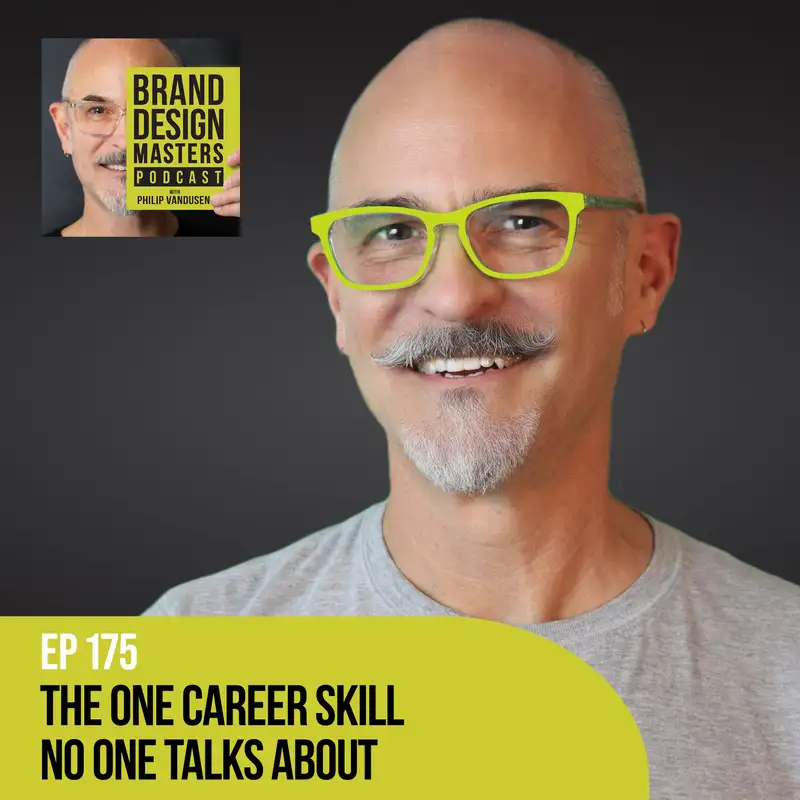
The One Career Skill No One Talks About
The One Career Skill No One Talks About
Philip VanDusen
Brand Design Masters Podcast EP 175
===
Announcer: [00:00:00]
Welcome to the Brand Design Masters podcast, the show dedicated to helping you build the skills you need to design bulletproof brands for yourself, your business, and for the clients and customers you serve. And now, here's Philip.
Philip VanDusen:
The following podcast comes from one of my recent YouTube videos or live streams. If you've ever checked out my YouTube channel, you know I share a ton of value there, so I'm now re-releasing the audio from some of them here on the podcast in case you'd prefer to listen as opposed to watching a video.
Sometimes I may make reference to an on-screen visual or two, but that just comes with the territory and won't detract from the content, I promise. Okay, so now let's jump into the episode.
Hey, everybody, welcome back. The one career [00:01:00] skill no one talks about. The hardest thing in a career is not starting something new. The hardest thing is letting go of something you've already built. And the more successful you are, the harder that becomes. When you've spent years building something, it stops being just a project.
It becomes part of your identity. You remember the effort that went into it, the people you met along the way, late nights and the small wins that slowly turn into something meaningful. Walking away from something like that doesn't feel strategic, it feels personal. But one of the paradoxes of having a long creative career is that the very things that helped you grow in one chapter can eventually start holding you back in the next chapter.
And if you want longevity as a creative professional, if you want to stay relevant and continue evolving over decades instead of years, you'll eventually have to let some things go, not because they failed, but because they served their purpose. I've been thinking about this a lot recently because I'm in the middle of one of [00:02:00] those transitions myself.
For the past decade, I've been building a solo branding consultancy alongside a content platform here on YouTube, and also a podcast, courses, speaking, newsletter, coaching, a mastermind community. And so like many entrepreneurs who step into the creator economy, the mindset for those years was simple: build.
Build more content, build more platforms, build more opportunities, more products, keep expanding the footprint. But at some point, growth turns into complexity, and complexity eventually forces the question: what actually matters the most? Recently, I made a decision that surprised even me. I was shutting down something I'd been running for seven years.
It was a Facebook group that I'd grown to almost nine thousand members at its peak, and at one point, it was an incredibly vibrant and active group. It connected thousands of creative professionals with each other. But over time, I realized something. [00:03:00] My energy was getting spread too thin. I wasn't showing up in the way that I wanted to in that group.
It was another platform that needed attention, and I was already trying to focus on several other areas of my work. When you reach that moment, you face a really difficult choice. You can keep something alive simply because you built it, or you can step back and ask a more honest question: Is this still serving me?
Or am I just afraid to let it go? That question is uncomfortable because every project you build becomes one of your babies. Remember the excitement of creating it. You remember all that early momentum, and letting go of that can feel like abandoning something that once really deeply mattered to you.
But one of the most consistent lessons I've learned throughout my entire career is that focus creates power. The more concentrated your energy becomes, the more impact things you choose to focus on tend to have. The [00:04:00] problem is, is that you can't focus if you're holding on to everything you've ever built.
This isn't a new lesson for me, by the way. The first time I had to confront it was much earlier in my life, long before branding and corporate leadership and consulting even entered the picture. Before that, I was a fine artist. I have my MFA in painting, and through most of my 20s, I was trying to build a life as a working painter.
I did portrait commissions. I sold work at galleries. I taught at the university level when teaching work was available. And if you grow up inside of the creative, the fine art world, there's a very strong romantic mythology around that identity. You are an artist. That's who you are. That is your being.
It's not just what you do, it becomes the story you tell yourself about your life. But as I approached my 30s, reality really started to set in, and I realized that the lifestyle that I wanted, the financial stability, the upward mobility I needed, the future I was [00:05:00] hoping to build, were not gonna come true in that path.
And that realization forced me to do something that was emotionally really brutal. I had to dismantle my painting studio. I had huge canvases stretched on wooden frames. I literally had to unstretch them, roll them up, and pack them away with the materials that had defined my personal identity for years.
I boxed up all of my paints and brushes and essentially shut down that version of myself. And at the time, it really felt like a betrayal. I felt like I was abandoning the thing that I had trained for and dedicated my entire life and existence to. But something really amazing happened after I made that decision.
The moment I let go of that identity, a huge amount of mental and emotional energy was suddenly freed up. All the internal tension and anxiety that I'd been carrying around whether I could keep pursuing that path simply disappeared. And that freed energy [00:06:00] allowed something else to emerge. That transition led me to design.
Design led me to creative leadership and roles inside major companies, and that led to brand strategy, which eventually led to consulting and content creation and the work that I'm doing today. In hindsight, letting go of one identity unlocked the next three decades of my career, and that experience taught me something that I now talk about all the time with the creative professionals that I coach.
Your career needs insurance. Most people think about careers like ladders. You start at the bottom and you climb upward through promotions and job titles, and each steps takes you higher than the last. But real careers are closer to being webs than ladders. You move sideways, you take side jogs, you explore new directions, you check out new possibilities.
Sometimes you pivot into something that looks completely unrelated at first, only to realize that all those threads are connecting. When your entire identity is wrapped up in a [00:07:00] single narrow definition of what you do, those shifts become terrifying. But when you've built what I call a career insurance, transitions like that become opportunities instead of threats.
Career insurance comes from developing what I like to call a V-shaped skill set. At the center of a V-shaped skill set is a deep expertise in something specific. Maybe you're a designer or a strategist or an illustrator or a marketer or a technologist, but the sides of the V represent a broader skill set of capabilities that surround that expertise: communication, business understanding, technology understanding, financial literacy, storytelling, leadership, entrepreneurship.
The wider that V becomes, the more resilient your career becomes, and that resilience matters more today than ever before because we are living through one of the most disruptive technology shifts in modern history. AI is transforming industries at an incredible rate. New tools, new workflows are appearing [00:08:00] almost daily, and many professionals feel like they're trying to drink from a fire hose of change.
Whenever this kind of disruption happens, two kinds of people tend to emerge. Some people cling to what they've already known and hope the change passes them by. Others lean into that shift and expand their capabilities. And history shows us really clearly which group tends to thrive. When desktop publishing arrived in the 1980s, I'm old enough to remember that, many designers believed it would completely destroy the profession, much like a lot of designers are feeling like AI is gonna destroy the profession.
Suddenly, anyone with a computer could design something, but instead of eliminating design, the technology expanded and expanded designers' possibilities and capabilities dramatically. And the designers who succeeded were the ones who embraced the tools and used them to amplify their creativity and their creative decision-making.
We're watching a [00:09:00] really similar transformation unfold right now, and that's why I sometimes joke that my job today is essentially being an insurance broker. My role isn't just helping creative professionals do their job better, it's helping you build a career that can adapt to change. It's about helping you develop the mindset and the skill sets and the strategic awareness that create what I call professional agency.
Control over your destiny. Because the real goal of a long career is optionality. Optionality means that when the world shifts, you have more than one path forward, and if there's one piece of advice I'd leave you with, it's this: don't try to navigate these transitions alone. Every major turning point in my own career happened faster and more successfully because I was connected to other people.
Mentors who offered perspective, peers who shared what they were learning, communities that exposed me to possibilities that I couldn't see on my own. Your network isn't just a list of contacts, [00:10:00] it's a learning system. It's a source of perspective when things get uncertain, and sometimes it's that support that gives you the courage to let go of something that once defined you.
It's that tectonic shift that can happen, that can be very painful and, uh, disorienting, that can be really helped along and facilitated by the people around you. Because the truth is that letting go is rarely the end of the story. In fact, it's the moment that creates the most space for the next chapter to begin.
And so if this kind of thinking resonates with you, I'd love to have you as a regular part of this community, and subscribing is the best way to stay connected to conversations like this one. So hit that subscribe button if you haven't already, stay creative, and I'll see you in the next one. If you enjoyed this episode of the Brand Design Masters podcast, it would be great if you'd take a moment to give us a star rating and review on your favorite podcast listening platform.
Also, if you'd like to stay [00:11:00] up to date on all the latest creative industry news, trends, resources, books, and articles, as well as my latest YouTube videos and live streams, head over to philipvandusen.com/muse and sign up for the Brand Muse newsletter. It's an industry leading publication that'll help you build and improve your creative practice, personal brand, and business.
That's philipvandusen.com/muse, M-U-S-E. Thanks again for listening, and bye for now.