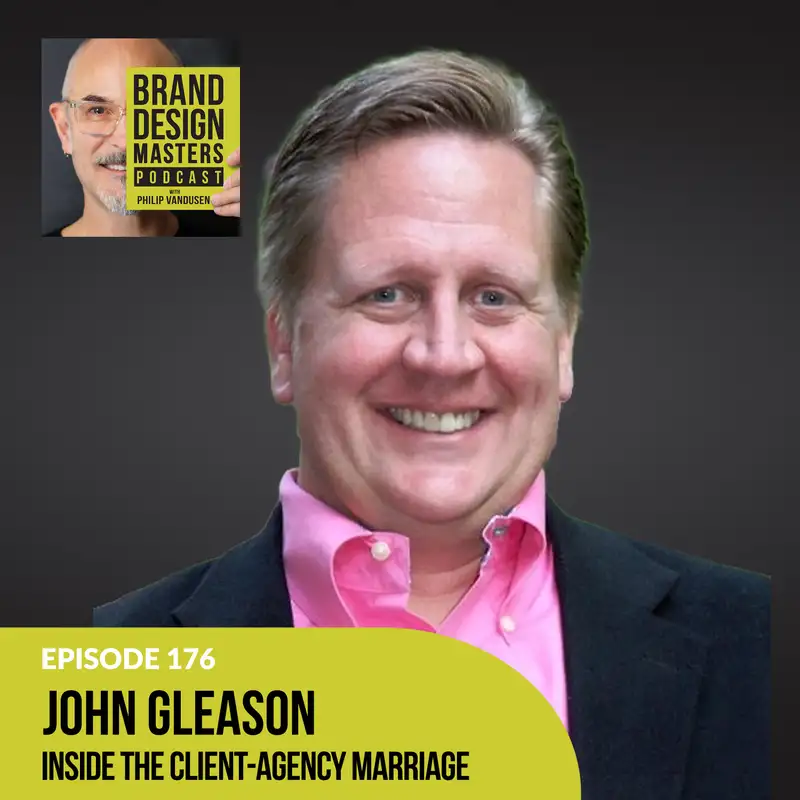
John Gleason: Inside the Client-Agency Marriage
Brand Design Masters Podcast EP 176
Interview with John Gleason
"Inside the Client-Agency Marriage"
INTRODUCTION:
Philip VanDusen: Hey everyone, welcome back to Brand Design Masters. Today's guest is somebody I've known for fifteen years, going all the way back to my days at Landor in Cincinnati. John Gleason spent twenty years at Procter and Gamble running Clay Street and managing outside agency relationships, and then he spent the next twenty years as an independent consultant, sitting right in the overlap between corporate design teams and the agencies that serve them. He calls it matchmaking and marriage counseling, and honestly that's the best description I've ever heard for what he does.
John's also the founder of A Better View Strategic Consulting, he's president of THE FUTURE OF... conference and The D Event, and he sits on the board of the Design Business Association. If you've ever wondered what's really going on behind the curtain of the client and agency relationship, this episode is for you. Let's get into it with John Gleason.
===
INTERVIEW:
Philip VanDusen: [00:00:00] Hey everybody, welcome back. I'm here today with John Gleason, and so we're gonna jump right into the questions. So John, welcome to the show.
John Gleason: I'm so honored to be here, Philip. I've known you for 15, maybe more years, and, uh, delighted to, uh, to have the chance to compare notes and share experiences.
Philip VanDusen: Absolutely. So we're gonna jump into what I think is one of your superpowers, networking. But I wanna start with a really straightforward question. You have zero website and one of the best personal brands in the industry. How does that work?
John Gleason: Um, it's very much a do as I say, not as I do. I I just haven't gotten around to it.
And I think part of it is probably something a lot of your listeners experience. It's the paralysis of, what is it I'm going to say when I do put it out there? And too many decisions, you know, narrow, broad. I [00:01:00] have big ambitions for what a website could be. Surveys and things because I, I do a lot of, of benchmarking and things like that.
And, you know, where do you draw the line? And so, I, I think one of these days, I, I have a URL, I have all of that. It, it is one day... And so thank you for calling me out, Philip. Um- I thought we'd
Philip VanDusen: do that right off the bat. Yeah, just lay that groundwork.
So you are, uh, in my opinion, one of the best networkers in the industry. You know everyone. You are a facilitator, a connector as we said in the intro, a marriage counselor in some cases.
And so you build amazing relationships and a breadth of relationships across the agency and, corporate side of the streets. And so what does real relationship building look like day to day for you versus the kind of transactional relationships that, let's connect on LinkedIn and those kind of more surface things?
What does relationship [00:02:00] building look like for you?
John Gleason: I, I think it comes down, Philip, to the first component of design thinking if, for those familiar with, with that process. It's empathy. And kind of a, a, a somewhat of a side story but related I, a, a part of my Procter & Gamble career experience was the left brain world of business, supply chain, operations, procurement.
Um, and I was, I was more of a right brain person in that left brain world, so sometimes that got me into trouble. But I think it, it's also my upbringing where my, my mom in particular said, "Go out of your way to understand the other pe- the other person, the other people, those around you." And so it, it kind of became a natural thing for me to be curious and I've just extended that.
I was, I was a big internal networker at Procter & Gamble when so many other people inside of big [00:03:00] companies aren't. Um, and, and kind of the analogy that somebody called out to me one day was, "I wanna get ahead inside of P&G because of what I've done, not because of who I know." And to me, the interesting anomaly in that is every year the, the, probably the most profound example is every year there was a rating process for every employee in the company.
They were rated on a one to five, and it was, it was force ranked, so no more than 15% of the population could be one rated. And for the first pass it wasn't that bad. So it's my team and I'm evaluating those that report to me or, or the, my boss is re- evaluating me and my peers. But as that rating process goes higher and higher and includes larger and larger populations of people, there are a lot of senior leaders who said, "I'm not gonna support a one rating for that person 'cause I've never heard of them And so just simply the idea [00:04:00] of that you don't have to suck up to people and you don't have to ride coattails, but it, just getting to know people and getting them to know you is important.
And I, I've continued to carry that forward. In fact, when I left P&G I set a goal for myself that I was gonna reach out to five new people every day, and I was gonna try to connect with at least one new person every day. And, you know, and, and in the very, very earliest days of my own consulting business, I didn't have clients, and I did...
You know, so part of this was how am I gonna keep my time, keep myself productive? And that, you know, that, that early goal setting became a, a, a part of my everyday activity and, and the, the, the interest of of curiosity in other people's journeys continues to exist. And, and one of the things that I, I operate by is I view I do view myself as a, as a pretty adept connector [00:05:00] But the mantra I tend to operate by is you have to collect the dots before you can connect the dots.
And so I see myself largely as a dot collector, and then through conversations, the connections begin to manifest themselves and begin to appear. It's like, "Oh, you should talk to so and so," and, "Oh, here's somebody." And, and, and the other thing it does for me, Philip, is by staying active, by connecting with other people, it keeps my aperture wide and not narrow.
Most corporate people that are focused on their business, their job, their competitor, their, their aperture isn't open to see an opportunity when something lands in front of them, or to know how to react to it when it does. And so part of it is just this, this productivity loop, if you will, of when I'm more active, I see more opportunities that come my way because the aperture is open.
Philip VanDusen: Within [00:06:00] this, is there some sort of repeatable version of that? Maybe not, it could be in a corporate environment, could be in an agency environment, could be someone who's just starting off in the industry and doesn't really have a lot of connections yet. Is there a repeatable version for, like, your introverted designer that they could actually follow to try to start building that network?
John Gleason: Well, I, I think there's an example that I'll, I'll use from the last The Future Of conference that we had. We had a panel of, uh, we, we called it Future Leaders. So these people were kind of newly promoted to the director level fairly young in their career and a lot of the, the conversation was how do you get senior leadership to see design?
How do you get them to understand design? How do you articulate value and things that we'll probably touch on later in the, the show here. But there was one panelist, uh, Bridget Greever, who is a newly promoted director of design at, uh, W.K. [00:07:00] Kellogg and she, she kind of talked about, getting this...
Using the promotion as a point of inflection to go get better connected to more people inside the company. And one of the questions that came from the audience, ironically, was, "How did you go about getting all those meetings?" And she kind of just looked and said, "I just started calling people."
And you know, and, and it doesn't have to be this big act. It doesn't have to be, um, it doesn't even have to be for a purpose. It's, you know, "Hey, I'm, I'm new in this role. I'd love to learn about Middle East and Africa business. I'd love to learn about regulatory. I'd love to learn about supply chain.
Can I come talk to you and we figure out, are there overlaps of things that we ought to do together?" And a part of it is it's easier for me to say because I'm, I'm not wired introvert but part of what I have found in talking to a lot of people that are wired [00:08:00] more introvert is if you can connect a purpose to that conversation, then it becomes a little bit easier.
If somebody else can introduce you into some of those things, it becomes an easier way to to get connected. And one of the things that, that I do when I encourage people that first I, I say, "If you, if, if you think that I might know somebody, let me know and I'm happy to do an introduction."
So I take the cold call off your plate. The second kind of the, the second tier of that, if you will, is, "Please feel free to use my name if you think that would open a door. And you don't have to ask me permission, I'm giving you bro- broad and blanket permission, and I hope you don't abuse it.
But but if you think that would help because maybe you don't wanna wait for me to respond or wait for me to, to, to do, uh, an introduction." And so part of it is how do you soften the, the idea of a cold call [00:09:00] and warm it up a little bit more by having somebody else intervene or using somebody's name that somebody might know?
And, and make it about the other person.
Philip VanDusen: That I think is one of the biggest unlocks is that for introverts especially when I counsel people and say, "Hey, if you wanna meet someone," people love talking about themselves. People, everyone loves talking about themselves. And most people don't realize when you are trying to get them to talk about themselves, they just start talking about themselves, but they, there's this kind of subliminal reciprocity that takes place, meaning that when they're talking about themselves and they know that you're interested in them, they suddenly treat you in a different way and elevate you in their perception.
So I always counsel people and say, "Hey, call. If you, there's someone you wanna meet or know, just call, email them, DM them, call them and say, 'Hey, I'd love to have an informational interview with you. I'm interested in what you do and I'd really love [00:10:00] to know more about it because I'm thinking about, exploring this avenue.'"
Or something like that. It makes it not about you. You're asking the questions. It's no true ask of them. They know they're not gonna get pitched to, right? They're not try- you know, you're not trying to get something from them. You're just trying to talk to them. And it opens, I've just found that it really opens these doors kind of magically I'll tell one really quick story though, John, is that they did this study that they took two people and they introduced them into a cocktail party situation.
One person they said, "You can only ask questions of the people that you're talking to. You can't talk about yourself at all." The other person they said, "Okay, if people ask you about yourself, tell them about your house, your dog, your wife, all the stuff, and talk about yourself, your business, what you do."
They did this test, and then they interviewed the people that they talked to, and the people who talked to the person who didn't talk about themselves at all and only asked them questions was rated as more [00:11:00] accomplished, more intelligent, more affable, more a better communicator. All these attributes that they never would have actually even had the opportunity to exhibit at that point, and because they were purely interested and listening, and that's exactly the principle that we're talking about.
John Gleason: Well, and, and, and the thing I'll, I'll, I'll carry this, this idea forward is it's no different for new business development if you're in an agency or if you're a freelancer looking for, for new work. It's no different for a job search. Um, one of, one of the big pieces of advice I give to people that find themselves in transition is never lead with the job.
Never lead with, "I'm looking for this thing." But don't ignore it. So when you, when you wanna reach out to somebody, maybe it's somebody you do wanna talk to about a potential job later, you could say, "I've found myself in transition for the first time in my career, and I wanna use this as an opportunity to learn from [00:12:00] people I respect."
And, you know, you, you haven't shied away from the job thing. And, you know, how, how honored are people gonna be if they're the recipient of, "I, I respect you, and you've done some cool things," or maybe even more specific, "I'd love to learn more about that thing you did two years ago," or, "You said this, and I'd love to hear what, what inspired that."
And again, people love talking about themselves, and if you can make it about them, they're more likely to accept the conversation and engage with you in it.
Philip VanDusen: Okay, so I wanna p- pivot a little bit. You are, in my opinion, one of the amazing experts at the corporate agency marriage, right? There's this...
And you understand both of those cultures very deeply, I think, and the inherent synergy that has to happen between them, but also the inherent friction that seems to [00:13:00] develop between them, and there's this culture gap. And so where do you feel that marriage breaks down most often?
John Gleason: Um, I'll share a story.
When I first landed in the design function at P&G, my primary was our outside agency relationships. And two big ahas, one that led me to leave P&G to do what I'm doing now, which is every agency sounds like every other agency when they knocked on our door, and they didn't know how to have a business conversation.
And then the other is uh, in getting to your question, it's the power dynamic that plays out between a, a client and their, their external service part that the, the client exhibits power because they have the money, they have the proj- projects, they have the decision power. And some of them don't realize they're wielding [00:14:00] power but are, you know, dictating things and, "Oh, no, it's gonna look like this, and it should look like that, and I hate this, and it's my opinion."
And... but the, the other thing that I find is and it's a bit of a frustration on my end, again, a reason that I wanted to get into this, this marriage counseling side of, of this, this business, is agencies or service providers acquiesce a lot of power to the client. The, you know, the examples I often use is the client service people inside of an agency often are, their primary job is to help not piss off the client. Milestones, deadlines, budgets, milestone, deadline, budget, milestone. And the thing that I think agencies could do so much better is the, the, the one thing that, that agencies have that clients don't is agencies have worked across dozens of categories and sectors and [00:15:00] clients and stages of business and business scenarios.
But I've rarely ever seen an agency play that card with a client. They tend to say, they tend to do the black box thing, "Oh, you know, we did our magic and here's the, here's the solution. Ta-da. Don't you love it?" And I, I do believe that if agencies had, had been more proactive about how they merged ideas from other sectors and categories and experiences, that fewer clients would be building in-house studios because, clients do this because they think it's faster and cheaper.
But the minute clients do this, they lose access to all of the other categories and visibility that agencies naturally bring to the table. But agencies rarely ever overtly brought that. You know, they w- I'd never heard an agency say, "Well, because we're in tech and haircare and [00:16:00] automotive that here's how we merged and, and mashed up a, a, a really cool solution for your baby care business."
Philip VanDusen: And,
John Gleason: and, and so, so one of the things that, that I think could be better at that intersection, again, thinking about empathy and understanding, is first of all, um, e- especially at the business development RFP pitching stage, clients do a really nice job with brands and corporations, but they do a terrible job understanding that there are humans sitting on the other side of that table.
And what are the reward systems, the worries, the concerns, the ambitions of those people sitting there? And it's almost always why the safe agency choice is the one that the client chooses, not the one that might be the right agency choice. You know, and, and, and, you know, no one gets fired by hiring, insert reputable brand [00:17:00] agency here.
You know, whoever, Landor or JKR, Interbrand, or whoever you, you perceive to be a safe choice. And part of that is the internal reputation of the people that might have to advocate for the outlier. And what does that do for their internal reputation if I advocate for a smaller boutique that might be a better fit for what it is we're trying to aspire to do with this category of this brand?
But, you know, I, you know, oh, the, the safe choice is X. And, and, and, and I just don't think there's enough honesty and, and vulnerability in these relationships. Agencies rarely say what's really on their mind Clients I, there, there's an exercise that I often do with clients or, or with agencies that is along the lines of how does the marketplace see you?
And one of the things I do is I ask for three groups of people [00:18:00] to interview. The first group is current clients. And I know the agency's gonna give me people that they love because it's gonna elevate and prop up the scores. But the other two groups are to me the more telling group. I wanna talk to people who no longer work with that agency.
And I wanna talk to people who have been knocking, you've been knocking on this client door for a long time, but they've never hired you. And I wanna get at, you know, why are you no longer working with them? And, and what I often find is in, in the preparation I often ask the agency for that middle group, the, the group that they no longer work with, w- why are you no longer working with them?
And most of the answers are the safe, "Oh, we went in a different direction," or, "We wanted a new set of eyes." And part of that was the client not wanting to be mean or angry with the agency. But I would say 75% of the time I get to something [00:19:00] that they, the client would never have said out loud.
You know, "Oh, Sally really, pissed us off during the meeting when she argued with us," or, "James came in with this idea that has nothing to do with our category and they weren't listening to us." And, and it's not about, you know, singling out individuals, but it's trying to get at the honesty of these relationships.
And, and, you know, again, the marriage counseling. Until you get to, I can't tell you how many agencies I've talked to that said, "Oh, we've never had an argument with our client." And my comment to them is, "You're obviously not pushing them hard enough or far enough." Or they have very low expectations of you.
Philip VanDusen: Yeah. Exactly. I think that one of the things that you and I have in common is that we both spent significant amounts of time on both sides of the street, right? I've worked in corporate for over a decade. I've worked in agencies for over a decade, and you have done the same. And one of the things that I think we've both [00:20:00] discovered in that is that, uh, what you were just talking about, meaning that there's there's an inherent power that agencies have that they don't flex, which is the understanding of how branding and s- brand strategy works across industries, how it's completely transferable across industries, categories, sectors, geographies even.
And the client side has a real difficult time seeing beyond their own product, their own category, their own geography, and they don't understand that these principles of marketing branding strategy are transferable no matter what category or industry that you're in. And agencies always kind of default to, like, talking about just that client's categories and so as not to scare them or confuse them or think that they don't-- that you don't understand what they are going through specifically.
I think that's a really, really interesting point. There's one thing I just wanted to mention. I've, I had an [00:21:00] amazing mentor at an agency I worked in, in San Francisco named John O'Meara, who was a managing director, who was the first guy who had faith in me to hire me into an agency, actually, after I left corporate, eh, The Gap.
And, uh, one of the things that he said to me I thought was brilliant when-- 'cause w-we-- when I walked in there, over fifty percent of our business was with Safeway, and they were deeply exposed by that, meaning that if Safeway had pulled back, they were gonna be in real trouble. And so my mandate was to pitch a lot and bring in a whole bunch of new clients.
And one of the things he said to me in, in pitch meetings, he said, "When you go into a pitch meeting, the first thing I ask people is, 'What are you struggling with?' before you ever even go to slide one of the deck. And if you can keep that conversation going and never get to the first slide in the deck, you've won."
And I just thought that was so absolutely brilliant, and it's so true. And it's exactly that kind of empathy that you're talking about exhibiting, that when you do that and show that empathy, [00:22:00] that's what gets clients to think that you really do care about them and want to solve their problem. Okay, I'm gonna shift to another kind of little topic, but this is an important one and I think very related, which is that y-you've kind of been talking a lot recently about kind of design's decline and why designers don't defend their turf well.
Why do you think that's happening? Why do you think designers let that happen?
John Gleason: I, I think let me take a half a step back on this, this idea that design is in decline. So th- this is a, a, a pattern that I've seen, 'cause I've been blessed to be able to peek inside 150 or more big corporations and 2,500 agencies.
And so, so some of this I get to see, you know, where are the crowds assembling on the square down below as I'm looking out of a balcony. And so, so a, a few things that I've seen, uh, just [00:23:00] kind of as measures that design is in decline. There are fewer chief design officers and EVPs and SVPs in corporations of design than there were 10 years ago.
O- one of the, one of the metrics that I track, I, I track about almost 250 companies and most of it is the organizational structure of these companies. And what I've found over the last eight years is 40% of these organizations have eliminated the top one or two levels of their design function And so the highest ranking person is no longer a chief or a VP, but, but now 49%, more, almost half, uh, the, the head of design, the highest ranking design person is a director or senior director level person.
And these are big, well-known corporations. Some are in tech and finance, and it's not just consumer goods. The other metric that I've seen, the first half of this metric is not surprising that, uh, about 85% of [00:24:00] these companies design reports to a different function. So they report to marketing or engineering or product or innovation or, um, someone other than having design as its own function.
That's not the surprising stat. The surprising stat is 74% of those organizations, so a total of about two-thirds of all these companies, design does not report to the head of that other function. So design is buried one or two or three levels deeper in marketing or in engineering or in product or in innovation.
And so in effect, they're a service organization cranking out objects and artifacts for this other function, not really seeing the world and trying to solve meaningful frustrations and problems. And so, so getting to, to your question about why so what I've diagnosed is the, the first is there are one or two generations of [00:25:00] C-suite people who have never experienced a, quote, "strategic design competency."
So they just don't know, and they call... they see design as h- whatever the, the, the organization has for design, and in many cases it's, for the lack of a better term, a decoration station. I'm moving pixels on a screen, or I'm decorating a package, or I'm creating the tactical elements of an environment.
The second dynamic is no one knows where to put design in the company Design is often restructured with a different reporting line every three or four years, even if the company isn't doing major restructuring. And then the last one is it's design's fault, 'cause design isn't there to defend what it is they're doing, what it is they're creating.
And again, there's no school for a design leader to teach them how to navigate the complexities of politics [00:26:00] or push back or defend with people that have more power and more, uh, level... high- higher levels and more power in the company. And so again, many of the design people shut up and row.
And connected to that is, is articulating value and impact is super hard. And I do think that there's an element that of all the functional areas in companies, I think there's a, a, an ethical ethos that designers have. Not to say that other functions are unethical but, but the ethos that designers have is they know that almost everything they create takes the village of other functions to go make it happen and bring it to life.
So many times designers don't want to go out and say, "Look what I did," because it took supply chain and operations and finance and regulatory and legal and, and these other organizations to bring it to market. [00:27:00] And as a result of not defending the fort, a- and I, I'll say this somewhat facetiously, the ad agency steps in and takes credit for everything and so part of this is defining value and impact.
And I'm, I'm very in- intentional around using the word impact. The Design Business Association in the UK is very deliberate around using the word effectiveness. So it's... So, uh, because I think one of the things that becomes a little polarizing, particularly for design, is the idea of ROI. ROI implies a mathematical calculation of financial output and financial value.
And design's contribution isn't always a direct calculatable financial outcome. You, you could get to approximate what that looks like. But for example, I often tell agencies and, and design teams, um, did you unlock a new consumer that you hadn't [00:28:00] been able to touch in the past?" Sounds like value.
And yes, you can absolutely do the math to go calculate what that could be worth, but why don't you just leave it as, "We unlocked this 40-year-old, uh, Gen- Gen X, Gen Z female consumer that, that had never bought our product before"? And then boom, end there. And, and now what else might we do to serve that consumer or that channel or that market or that region or that demographic?
Um, and so part of this is how do you go have those conversations? O-one of my favorite kind of ubiquitous example is, um, any time a designer has shown a senior leader something that involves purple, inevitably it's, "Well, I don't like purple." And so many designers just, they cower to that, that, you know, the, the president of the [00:29:00] division says, "I don't like purple," and, "Okay, well, I'll go show it to you in green."
But instead I, I always u-use this, this idea for defending work, is blame someone else, and the someone else should always be the consumer. "Well, I appreciate your opinion about purple, but the consumer told us they wanted royalty and decadence and luxury, and there's no better color for our brand than purple."
Philip VanDusen: Yeah. I think that's one of the things, the core aspects of creating visual work is the understanding of semiotics and what designs, shapes, colors, fonts, what they convey to people and what emotions they stir. And whenever you're trying to get anyone to do anything, you have to stir some sort of emotion, some sort of need, some sort of empathy, some sort of something.
And I think that that's the one piece that design has fallen down on, is [00:30:00] really embracing the idea of semiotics and how to communicate that. Because to upper management, to help, like you said, blame someone else, I love that perspect- that kind of terminology. I never used it that way, but that's exactly what I've been doing my whole career.
It's like you may not like green, but green conveys growth," and you know. It's like, look at the entire natural foods category. Um, so okay. So w- design effectiveness. When it comes to that, how do you think designers can best start to articulate that? Say, okay, say we're a design director inside of a company, one of the companies you were just talking about, where they have now kind of stripped away the upper m- close to C-suite level management and design, and now design is operating under the marketing CMO, and at the h- the, the most highly [00:31:00] titled person is the director of design.
And so how does that person go about m- finding some visibility to upper management so they can start to tell that story?
John Gleason: I, I think it, there, there's a bit of repeatable content in this discussion. I think the first thing is why not sit down and have a conversation with your cross-functional peers to say, "What are you trying to achieve?
What are you afraid of? Why hasn't this worked before?" Be- because I think design, because of their natural curiosity for consumer and, and this is, this is one of the, the weird anomalies that I have called out. I've called it out in the first d- the Future Of conference where our, uh, our theme was Is Design Dead?
It got to a point of a fairly typical design conference where the conversations start, "Well, why don't they understand us? Why don't [00:32:00] they invite us sooner? Why don't they give us a seat at the table?" And you know, and part of it is almost a, an entitlement kind of be- beh- behavior. It's like, "Well, we deserve a seat."
And it's like if you can't prove that you deserve the seat, you're not gonna get the seat. Um, but part of it is, is I asked the question of the room, "Have any of you for one minute thought about the, the, had empathy for your CEO?" What it is they have to deliver, the pressure they're under to to deliver those things, and then mapping, is there anything I can do to help that?
Instead of being the recipient of briefs and the recipient of activity, proactively turning that back. And it doesn't have to be the CEO, it can be your, your peer, colleague, same level. It can be your bosses. It's like, "Okay, what are we trying to achieve?" And just building that [00:33:00] over time so that six months from now you can lean on something that a brand manager once said, "Say, you were worried about this.
Are you w- still worried about that, or did we solve that in the last initiative?" The, the other thing that I encourage design leaders in corporate and agencies to do is find ways for the client to give you the initiative objective information, and you build that into the brief. Because if it's built into the brief, they almost have to give you the results afterward.
Did we meet the launch objectives? Did we? Did we? Did we?" And e- I can't tell you how many agencies in particular say, "Oh, well, the client doesn't give us that information." It's like, well, you could just outright ask for it.
Philip VanDusen: At the b- at the beginning of the ha- the brief stage- At, at the beginning and-
is the best place to ask for it, because th- that's where the interrog- the, the interrogation happens, right? In order to make a brief stronger before you're actually launching. Um-
John Gleason: And as with, and, and you know [00:34:00] this, Philip, the, that too many companies jump to ideation and problem-solving before they've even defined what problem they're trying to solve.
So design has the opportunity to be much better at a crisp, sharp problem statement, and it could be as simple as we're, we're trying to solve this problem for whom, for what outcome and, and, and then that then begins to, to create the frame for effectiveness and impact. It's, you know, "Oh, we wanna see a 10% bump in retail sales in the first three months of this launch."
Great, let's build it into the brief, and then the solutions can be mapped to, does this solution have the right to deliver that objective? And the thing I'll share for, particularly for the designers who may not be as, as comfortable with business metrics and [00:35:00] outcomes if your clients, if you're an agency or you're an in-house designer and your internal client is saying the problem is a, a financial metric, we have a revenue problem, we have a profit problem, we have a market share problem, keep pressing them because that's not the problem.
That's a symptom of something else. There's a reason somebody's not buying something. It's not a revenue problem, it's, you know, a relevance problem or a competition problem or a effectiveness problem or, you know, maybe they don't understand us. And so, so keep pushing those business partners to say that's not a problem.
That's a measure, a metric, or a symptom and let's, let's try to get at what problem are we trying to solve
Philip VanDusen: One of the things that you just mentioned was competition, and we know that business is all about competition, and there's competition in the agency world between agencies. There's competition in the, you know, the category of industry [00:36:00] with consumers.
And w- before we hit record, on a previous conversation, we were talking about competitive audits. And I've always found in now working with small and medium-sized businesses that m- m- oftentimes these companies, 10, $100 million companies, have really no clear idea of what their competition is doing or why their lunch is being eaten.
And until they're shown that, they they have no concept that they're not operating in a blue ocean, right? They're operating in a red ocean. And so the power of the competitive audit, in my opinion, does more to be able to sell and work than any kind of pitch or any kind of creds presentation that you can give.
It's like just show the client what their competition is doing and then what they're doing, and your project will write itself. And so, but one of the things we were talking about [00:37:00] was the competitive audit in regards to agencies. And we were saying how agencies, number one, agencies never keep their websites updated, and we're the last people to be talking about, keeping things current online.
But the- one of the things that agencies never do that they're always advocating for with their clients is a competitive audit. And I, I asked this question to a mastermind community I was running recently and saying, "Hey, how many of you have actually done a competitive audit of people in your industry, other designers who are going for the same clients that you are?"
And they're like, "Humana-humana-humana-humana." Like, they, they have never done it. And so why do you think that is?
John Gleason: I, I the quick and dirty answer is it's a, it, it's a business decision. Because agencies don't have a lot of spare capacities, people sitting around twiddling their thumbs to say, "Oh, I'm gonna go look at my own brand today."
Um, because, everything [00:38:00] is about utilization. You know, how, what percent of my people are being billed out at what rates and what capacities and things. The, the second thing I think is because agencies do this for a living, they believe they can do it in their sleep for themselves. And it looks like they've done it in their sleep, because many of them they claim, you know, "We're different because..."
And then the words that follow are the same things that most of their key competitors might be saying. And then I think the other thing relates to, you know, you calling me out for not having a website, is strategy is not only making a decision about what you are going to do, but it's making decisions about what you're not going to do.
And agencies aren't very good about the latter, because they're always, you know, "Hey, Philip, can you help me do a website?" And, "Hey, can you help me do structure, and can you help me create an environment?" And, you know, most agencies [00:39:00] are gonna say, "Well, yes, of course we can." And then they're gonna call their, back to the, "Who, who do we know that can help us do a website?"
Or, "Who, who do we know that can help us build a park?" Um, and so part of it is, is th- this, this i- idea and ambition. So on the good side, your comment around the skills are transferable across categories and products and things. But a lot of times agencies are willing to risk the idea of extra income, or is it gonna be a good outcome?
And, maybe I don't know how to do a website, but I'm gonna hire two freelancers and maybe I partner with somebody that can, and it's probably gonna be okay. A- and so I, I think it's just part of this is taking the time to go do those things. So one of the things that I often share with agencies is stop trying to scream about how different you are, because you're not, and start learning how to whisper how relevant you are to the people you're [00:40:00] talking to in that moment And because relevance will always win over difference.
Clients don't care if you're different. What they want is relevance. And, and I've, I've, because I've had a chance to peek into, uh, 2,500 agencies, I've also taken my... So one of the things Procter & Gamble taught me is measure a whole bunch of crap. Some of it's gonna be meaningful, and you'll keep measuring it.
Some of it you're gonna find that it's not useful. And one of the things that I've done is I found across those 2,500 agencies, there are eight things that virtually every agency says. Wow. And one of them is, "We have a proprietary process." And A, first of all, it's not proprietary, 'cause just look at it.
It looks like a 4D or a double diamond
Philip VanDusen: or- You just named it something, you just named it something different, something cool.
John Gleason: Exactly. Exactly. Maybe you even trademarked it or copyrighted it but it's basically the same process. But the other [00:41:00] angle on that is clients don't care that it's proprietary.
Clients want to know that it works Because you're probably gonna show them some case studies where you used your process, and they're gonna wanna say, "Oh, can I get that 15% bump in revenue that, that you showed me from the cat food company that you did this for?" And they want the safety and security of a process because it, it implies stability.
But I can't tell you, there, there must be 10 or 15 agencies that overtly said, um, "We could build our process however you want us to build it." And it's like, well, wait. But now you have no expertise. You're admitting that you're gonna acquiesce to me, and I don't have the view of 50 or 100 other clients and experiences and things, and people that have come from other agencies that you have to build your process.
Um, and, [00:42:00] and some of them are non-statements. The number one thing is every agency talks about their people, but I've never met an agency that says, "Ah, we make do with the mediocre talent that are willing to come work with us." I mean, what else are you gonna say about your people other than that they're great?
And the problem is you're in a, in an industry that has 30, 40, 50% turnover each year. So your people were someone else's people last week, and they're gonna be someone else's people next week. So the people thing it's a non-statement, and it doesn't differentiate you.
Philip VanDusen: Yeah. No, it definitely does not.
All right, we're coming up on time, so I wanna talk about one thing, which is the big elephant in the room in virtually any conversation in marketing and design these days, which is AI. And there's huge hype around AI and how it's going to be... It's just going to destroy the design industry. It's gonna take all our jobs.
Chicken Little, the sky is falling. And I was talking to someone I know who's very high up in Aquent, [00:43:00] who's the staffing agency, and she s- they recently did a very in-depth study to find out how companies are currently using AI inside of companies. And what they found out was that very few of them are actually using it for, to create design.
They're actually using it just to automate processes and the sorts of, kind of daily task, repetitive, things that designers used to have to m- handle and automating those with agents, taking them off their designer's plate so they have more time to design. And so what are you actually hearing from enterprise level contacts or your, about how AI is being used day to day?
And where do you think AI could conceivably change the creative role in the next few years, if you had to put on your Nostradamus hat?
John Gleason: A, a, and a couple of thoughts, Philip. The, the, the first is I have, uh, i- if w- [00:44:00] when it comes to a, an agency introducing themselves to a client early on in that process, or maybe it's an RFP I, I have seen the, it, that AI is a trick question Because what I've, I've seen 20, 25 client companies say well, I've seen 100, let, let's just use 100 for math's sake.
100 client companies ask, "How are you using a AI? How are you leveraging AI? How does that help us?" And the trick question comes in that, that they have not divulged, do they see AI as a risk or do they see AI as a benefit? So if agencies go in and say, "Oh, we're all over AI and we've got teams, and we've got this, that, and the other," the client could back, come back and say, "We don't want you doing that on our business.
We don't wanna run the risk of, of obfuscating a design that is primarily [00:45:00] designed by AI and then tweaked by humans because we don't wanna be sued, or we don't want this, or we don't want that." Or the other side is the agency says, "Oh, you know, we're dabbling in it," but the client says, "Well, we really need you to take the lead, and we need you to..."
So there, there's, you know, part of it is, is I encourage all agencies and freelancers and people on the outside of these corporate organizations to try to poke at these companies to say, "How are you leveraging AI, and how would you like me to leverage it?" Obviously, the, the how would you like me to do it is a little harder in a new relationship or an RFP.
Um, but the, the most common, um, activity that I've seen on either side is helping people become smarter faster about a category, a product, a sector. You know, going out and doing an AI category audit, you know, the, be- you know, even as [00:46:00] part of the RFP be- before the client has even asked for it.
"Hey, what's happening in shampoo? What's happening in dog food? What's happening in this?" And let AI come back with things, because inevitably it will always uncover something that that they hadn't been thinking about. "Oh, I hadn't considered that," or, "Oh, I didn't even know that player was in dog food."
And so it's research, it's insight, it's inspiration and some of it might lead towards, "Show me some ideas about how to visually bring to life this idea," you know, cinnamon or dog food or, um... And again, not going all the way to, to having AI create it. But the, th- there's a general perspective that I have, Philip, that is if the enterprise you're, you're operating in, and I'm speaking mostly to the corporate side designers and design leaders and even marketers and CEOs and others- [00:47:00] If the enterprise operates by a good enough is good enough kind of mentality, AI probably will replace the creatives and designers and writers and, and photographers in those businesses because they don't care about getting to great.
They just wanna push something good enough out, and at some point there are gonna be lawsuits, and at some point there's gonna be infringement or the, the, the potential of infringement because they, they're not seeking excellence. The, the organizations that leverage AI to help inspire some foundational ideas and then let the humans refine it to create that emotional connection to drive a call to action that, that...
'Cause machines just can't do that today. I mean, the machines come across as being empathetic because they wanna, "Oh, yes. Oh, I'm sorry, Philip, you're right, that two plus two
Philip VanDusen: does not equal six." [00:48:00] They're
John Gleason: overly, overly agree...
Philip VanDusen: They're overly agreeable, as they've found.
John Gleason: Right. And so, so I, I do think that everybody needs to be playing with it.
Everybody needs to be striving towards something bigger. And, and for example, a world that you know well, that I know well, and many of your listeners no doubt know well, is I know a few agencies that are experimenting with AI by building... they've started by building fake brands and creating robust brand guidelines and building it into an AI agent.
And the, the experimentation that they're going through is the first wave is they create line extensions or new brand architecture or something and, and then use AI to say, "Is this on brand? Is this on equity?" And then the next extension is they just simply say, "Oh, I want a cinnamon line extension," and, you know, go, go build, the, the, the eight representative [00:49:00] SKUs across club and...
and so, so these agencies are building models where not only are they planning to design the artifacts for the clients, but they're designing a model where they're creating the brand guideline, the underlying brand guideline platform, which potentially makes it harder for the client to move away from that agency if they, you know, if I've...
And I'm making this up. If I'm Kraft Heinz and I've got Heinz Ketchup built into these sophisticated AI models that will test and validate whether something's on brand- It's largely sitting on that agency's agent, and the agency may not be as willing to give up the secrets of how they built that if the, if the client changes agencies.
Philip VanDusen: Yeah.
John Gleason: And so super smart kind of business model to try to create a moat around themselves for something that many people might see [00:50:00] as, as an interchangeable capability.
Philip VanDusen: Mm. So this has been an amazing conversation, John. I really appreciate your coming and talking to to us here. If there's kind of one thought or a mantra that you try to run your consultancy by in how you work with clients, what would that be?
John Gleason: Uh, well, there, there is one that I operate by and I, I offer it as a suggestion to other people, is... and it's along the lines of what we talked earlier, is seek to serve, not to sell.
Philip VanDusen: Mm.
John Gleason: So again, have the curiosity to understand the humanness of the people you're trying to connect with.
And can you uncover, you know, that, that brand manager that's in the RFP that might be pivotal in this decision? Does she feel like this is the project that could get her promoted or could get her fired? And how do you allay those, those fears? And, and the big one and I kind of touched on it, [00:51:00] is agencies' tendencies to say yes when a client says, "Oh, can you do a website?
Can you do environments?" Resist the urge to do all of those. Because if you're truly a good partner for them, you may say, "You know what? That's not in our wheelhouse, but I know three people who would be great at this." And now all of a sudden you've accelerated their ability to go find somebody that could go do this.
You're a trusted resource, so it's likely that that person or those, those groups might land something new without a lot of RFPs and, and searching. And you didn't try to do it when it's not in your wheelhouse. And, and I think a lot of, of client side people appreciate that. A, a lot of them appreciate the fact that you can do everything but are you exceptional at everything?
Philip VanDusen: I think that's brilliant. Seek to serve, not to sell. So excellent. Um, John, [00:52:00] where can people find you if they need your brain?
John Gleason: Uh, the, the easiest place is, uh, john@getterbetterview.com, uh, or LinkedIn, John Gleason, look for the pink shirt. And, uh, and if anybody that's interested, you can also see thefutureof-conference.com 'cause I'm in the process of collecting speakers for next year's the theme for next year.
So first year it was, Is Design Dead? This past year is, Are You Ready To Lead? And then the next year is gonna be Creating The Conditions, and this idea of, of how do you go create the things that help design deliver better business impact and better world impact.
Philip VanDusen: I love it. John Gleason, thank you so much for coming to the Brand Design Masters podcast.
It's always great to talk to you.
John Gleason: I'm so honored, Philip. Thank you so much.